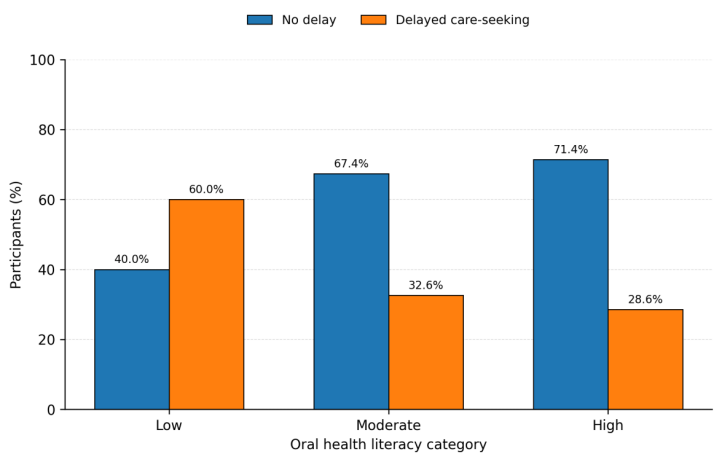
Figure 1: Oral Health Literacy Category and Delayed Dental Care-Seeking Among Participants Reporting an Oral-Health Problem (n = 92)
Aliya Ameen1* | Shanza Akram1 | Maham Riaz1
1Department of Pathology, Asian Institute of Medical Sciences, AIMS Karachi, Pakistan
*Correspondence: Aliya Ameen (draliyaameen@gmail.com)
Received: 20 September, 2026; Revised: : 21 October, 2026; Accepted: 23 October, 2026; Published: 30 October, 2026
Background: Oral health literacy can impact preventive dental attendance and early care-seeking. This study aimed to determine the relationship between oral health literacy and dental care-seeking behaviors in adults. Methods: 130 adults' data from July to December 2023 was analyzed. A 12-item questionnaire was scored from 0–12, with 0 indicating a low level, 12 a high level, and intermediate scores a moderate level. Statistical analyses included descriptive statistics, chi-square tests, the Mann–Whitney U test, and binary logistic regression. The regression was only conducted in participants who reported having an oral-health problem (N = 92) and adjusted for age, sex, education, literacy score, and household income. Results: Participants' mean age was 38.6 ± 11.1 years; 65(50.0%) had a moderate literacy level, and 98(75.4%) had a previous appointment with a dentist. 56(43.1%) reported regular/preventive attendance and 42(32.3%) reported symptom driven attendance. The attendance pattern was correlated with literacy category (χ²=25.22, p<0.001). Among participants reporting oral-health issues, 36(39.1%) delayed care, with differences by literacy category (χ² = 6.38, p = 0.041). However, continuous literacy scores (p = 0.116) and adjusted regression (aOR = 0.858, 95% CI: 0.688–1.072; p = 0.177) showed no significant association with delayed care. Conclusions: There was a general correspondence of attendance with categorical literacy levels; however, no clear correspondence was identified for adjusted associations. Validated measures and larger samples could be used in future studies to evaluate literacy in relation to access barriers.
Keywords: Cross-Sectional Studies, Dental Care; Health Literacy; Health Services Accessibility; Oral Health.
Oral health literacy (OHL) is the capacity to acquire, comprehend, and use oral-health information to support prevention and treatment choices, and could affect oral-health behaviors 1. A recent scoping review revealed inconsistent relationships between adult health literacy and dental-service utilization, which in part was due to differences in the measures used to assess health literacy and the outcomes measured across studies 2. The relationships between OHL and dental anxiety and dental-service use have also been studied in patients seeking dental care, with a possible implication of informational and psychological factors in care-seeking 3. Cross-sectional studies of nurses have investigated the relationship between OHL and oral-health behaviours, and a scoping review of culturally diverse adults has assessed oral-health knowledge, perceptions, and barriers to oral-health decisions 4,5.
The relevance of health beliefs in the understanding of dental-visiting behavior was also demonstrated in an adult instrument-development study 6. However, other than literacy, predisposing characteristics, enabling resources, and healthcare needs were found to be important factors in dental-service utilization, as revealed by a systematic review 7. Other reviews have also found that cost, access to services, geographic distance, and psychosocial and cultural factors are impediments to dental services 8. Another study of adult Americans in the United States also looked at social determinants and their connections with dental visit frequency and oral health disparities 9. In adults, a systematic review found that there was minimal research evidence regarding interventions to encourage regular dental attendance when seeking care primarily when symptomatic 10. Although there has been increased research interest, the relationship of oral health literacy to preventive attendance and delayed dental care is not fully understood. These outcomes can be explored together, with other potential determinants, to provide a structured approach to exploring the care-seeking patterns.
This study aimed to describe what oral health literacy is and dental care-seeking behaviors among adults. It explored the relationship between categories of literacy and the frequency of dental attendance, and the relationship between delayed dental attendance and those who reported oral-health issues. It also analyzed continuous measures of literacy by delay status and examined demographic and socioeconomic factors associated with delayed care using logistic regression.This descriptive analytical cross-sectional study (July 2023-December 2023) determined the level of oral health literacy and oral health-seeking behaviour among adults by exploring the links between oral health literacy and dental care-seeking behaviours, such as routine dental visits, symptom-driven visits, and delays in health professional dental care at authors’ affiliated tertiary healthcare settings based on Strengthening the Reporting of Observational Studies in Epidemiology (STROBE) guidelines. Adults (18 yrs or older) were eligible for inclusion. All participants were asked to share their information on their knowledge, hygiene, and attitude towards seeking dental care. The participants under 18 years of age and those who did not have full information on the main study variables were excluded. A total of 130 adults were included in the study. The sample size was determined using OpenEpi version 3.01 (released April 6, 2013, Atlanta, GA, USA) 11. The sample size was calculated using the single-population proportion formula (n = Z²p[1 − p]/d²), with a 95% confidence level (Z = 1.96), an expected prevalence of p, and an absolute precision of d, yielding a minimum sample size of n.
A consecutive sampling technique was used, whereby eligible adults attending the healthcare setting during the study period were recruited consecutively until the target sample size was achieved. A structured questionnaire was used to collect data regarding sociodemographic factors, OHL, OHP, and DHB. Sociodemographic factors were age, sex, education level, working status, and family income per month. Oral health variables were self-reported oral health problems, history of dental visits, and frequency of toothbrushing. Oral health literacy was the primary independent variable, and dental care-seeking behaviour was the primary outcome. There were other factors, such as whether or not children attended dental services on a regular basis, and delays in seeking dental care or perceived barriers to accessing dental services. Oral health literacy was evaluated through a structured questionnaire that included the domains of dental caries, periodontal disease, preventive oral hygiene, and oral health information. A composite score was calculated, with those with higher scores being better readers. Low, moderate, and high oral health literacy groups were defined based on previously established score cutoffs. Dental care-seeking behavior was evaluated by responses to dental visits and their reasons, and timing of dental care. Daily attendance at a dentist was determined as having seen a dentist for routine care or preventive care. Symptom-driven attendance: when the main reason for attending was one of the symptoms (pain, swelling, bleeding gums, or other oral symptoms). Delayed care seeking: When individuals had an oral health problem but did not seek dental care. The same operational definitions were used for the entire analysis.
The data were first entered into Microsoft Excel (Microsoft Corporation, Redmond, Washington) and then analyzed using SPSS version 26.0 (Armonk, NY: IBM Corp.). Means and standard deviations were used to summarize continuous variables, and frequencies and percentages were used for categorical variables. Dental care-seeking behavior was assessed for association with OHL using the chi-square test or Fisher's exact test (when applicable). A binary logistic regression model was used to determine factors related to dental care-seeking delay, such as age, sex, education, income, and oral health literacy. Association(s) were reported as adjusted odds ratios (OR) with 95% confidence intervals (CI). Statistical significance was defined as a two-sided p-value of less than 0.05. The study was conducted in accordance with the ethical principles outlined in the Declaration of Helsinki. Ethical approval was obtained from the institutional ethics review committee before data collection. Written informed consent was obtained from all participants before enrollment.
A total of 130 participants were included in the study, with a mean age of 38.6 ± 11.1 years and a median age of 38.0 years (IQR: 30.2–47.0). There was an almost even distribution of participants by sex, with 66 males (50.8%) and 64 females (49.2%). In terms of education, 42(32.3%) reported a graduate-level education or higher, and 36(27.7%) reported secondary education. The majority of participants were working (74, 56.9%), and 64(49.2%) were classified as middle income. As for oral hygiene habits, 68(52.3%) respondents brushed their teeth one time per day, and 48(36.9%) respondents brushed twice or more times per day. 73(56.2%) participants used additional oral-hygiene aids, and 57(43.8%) did not use any oral-hygiene aid Table 1.
| Variable | Category / Representative Summary | Statistics | Age (years) | Mean ± SD | 38.6 ± 11.1 | Median (IQR) | 38.0 (30.2–47.0) | Sex | Male | 66 (50.8%) | Female | 64 (49.2%) | Education level | Primary or less | 26 (20.0%) | Secondary | 36 (27.7%) | Higher secondary | 26 (20.0%) | Graduate or above | 42 (32.3%) | Employment status | Employed | 39 (42.9%) | Unemployed | 15 (11.5%) | Homemaker/other | 37 (28.5%) | Household income level | Low | 64 (49.2%) | Middle | 64 (49.2%) | High | 20 (15.4%) | Toothbrushing frequency | Less than daily | 14 (10.8%) | Once daily | 68 (52.3%) | Twice or more daily | 48 (36.9%) | Additional oral-hygiene aids | No | 57 (43.8%) | Yes | 73 (56.2%) |
|---|
Note: Values are presented as frequency (percentage), unless otherwise indicated. SD = standard deviation; IQR = interquartile range
The majority of participants were seen by a dentist before (98, 75.4%), and 92(70.8%) reported having an oral health problem. The mean OHL score was 6.28 ± 2.75, and the largest proportion of participants (65; 50.0%) fell in the moderate category. 56(43.1%) participants reported regular or preventive dental attendance, and 42(32.3%) reported going to a dentist for symptoms. The most commonly reported barriers were: low awareness or low perceived need (21, 16.2%) and no perceived barrier (43, 33.1%) Table 2.
| Variable | Category / Representative Summary | n (%) or Summary | Previous dental attendance | Never | 32 (24.6%) | Ever | 98 (75.4%) | Time since last dental visit | Never | 32 (24.6%) | Within 12 months | 24 (18.5%) | 1–2 years ago | 35 (26.9%) | More than 2 years ago | 39 (30.0%) | Reported an oral-health problem | No | 38 (29.2%) | Yes | 92 (70.8%) | Oral health literacy score | Mean ± SD | 6.28 ± 2.75 | Median (IQR) | 6.0 (4.0–8.0) | Oral health literacy category | Low (0–4) | 35 (26.9%) | Moderate (5–8) | 65 (50.0%) | High (9–12) | 30 (23.1%) | Dental attendance pattern | Regular/preventive | 56 (43.1%) | Symptom-driven | 42 (32.3%) | No previous attendance | 32 (24.6%) | Main perceived barrier | None | 43 (33.1%) | Cost | 19 (14.6%) | Fear/anxiety | 19 (14.6%) | Time/work | 19 (14.6%) | Distance/transport | 9 (6.9%) | Low awareness/low perceived need | 21 (16.2%) |
|---|
Note: VValues are presented as frequency (percentage), unless otherwise indicated. Percentages are based on the total sample of 130. SD = standard deviation; IQR = interquartile range.
The most reported oral health problem was Toothache (46 (50.0%)), followed by Bleeding gums (21 (22.8%)). 12(13.0%) and 13(14.1%) participants reported the occurrence of tooth sensitivity and swelling or other problems, respectively Table 3.
| Primary oral-health problem | Frequency (n) | Percentage (%) |
|---|---|---|
| Toothache | 46 | 50.0 |
| Bleeding gums | 21 | 22.8 |
| Tooth sensitivity | 12 | 13.0 | Swelling or other problems | 13 | 14.1 | Total | 92 | 100.0 |
There was a statistically significant relationship between the category of OHL and the dental attendance pattern (χ² = 25.22, p < 0.001). There were statistically significant differences between the regular/preventive attendance rates of high literacy participants (22; 73.3%), moderate literacy participants (28; 43.1%), and low literacy participants (6; 17.1%). On the other hand, those who had low literacy had the highest attendance because of symptoms (19; 54.3%), as shown in Table 4.
| Oral health literacy category | Regular/preventive attendance, n (%) | Symptom-driven attendance, n (%) | No previous attendance, n (%) | Total |
|---|---|---|---|---|
| Low | 6(17.1) | 19(54.3) | 10(28.6) | 35 |
| Moderate | 28(43.1) | 22(33.8) | 15(23.1) | 65 |
| High | 22(73.3) | 1(3.3) | 7(23.3) | 30 | Total | 56(43.1) | 42(32.3) | 32(24.6) | 130 |
There was a statistically significant relationship between the category of oral health literacy and delayed dental care seeking (χ² = 6.38, p = 0.041). Participants who had low literacy had the highest rate of delayed care-seeking, 56(60.0%), followed by those with moderate literacy, 15(32.6%), and high literacy, 6(28.6%). In sum, 36(39.1%) participants delayed dental care Table 5.
| Oral health literacy category | No delay, n (%) | Delayed care-seeking, n (%) | Total |
|---|---|---|---|
| Low | 10(40.0) | 15(60.0) | 25 |
| Moderate | 31(67.4) | 15(32.6) | 46 |
| High | 15(71.4) | 6(28.6) | 21 | Total | 56(60.9) | 36(39.1) | 92 |
Figure 1 illustrates the distribution of delayed and non-delayed dental care-seeking across oral health literacy categories. Delayed care-seeking was more frequent among participants with low literacy (15; 60.0%) than among those with moderate (15; 32.6%) or high literacy (6; 28.6%).
Figure 1: Oral Health Literacy Category and Delayed Dental Care-Seeking Among Participants Reporting an Oral-Health Problem (n = 92)
For all group members, the median OHLS scores were slightly higher for those who did not delay dental care (6.5, IQR: 5.0–9.0) than for those who delayed dental care (6.0, IQR: 3.0–8.0). This difference was not statistically significant, however (Mann–Whitney U = 1204.0, p = 0.116) Table 6.
| Delayed care-seeking status | n | Median literacy score | IQR |
|---|---|---|---|
| No delay | 56 | 6.5 | 5.0–9.0 |
| Delayed care-seeking | 36 | 6.0 | 3.0–8.0 |
Multivariable logistic regression was performed, and none of the factors studied was found to be significantly associated with delayed dental care-seeking (all p > 0.05). There was no statistically significant association between oral health literacy score and delayed care (adjusted OR = 0.858, 95% CI: 0.688–1.072, p = 0.177). Other factors such as age, sex, education level, and household income were also not significantly associated with delayed care seeking Table 7.
| Predictor | Adjusted OR | 95% CI | p-value |
|---|---|---|---|
| Age (per one-year increase) | 1.011 | 0.971–1.053 | 0.591 |
| Female vs male | 1.260 | 0.521–3.043 | 0.608 |
| Secondary vs primary education or less | 1.383 | 0.370–5.163 | 0.629 |
| Higher secondary vs primary education or less | 1.140 | 0.242–5.370 | 0.869 |
| Graduate or above vs primary education or less | 1.162 | 0.248–5.440 | 0.849 |
| Middle income vs low income | 1.335 | 0.435–4.098 | 0.613 |
| High income vs low income | 1.125 | 0.252–5.029 | 0.877 |
| Oral health literacy score (per one-point increase) | 0.858 | 0.688–1.072 | 0.177 |
Most participants had moderate oral health literacy, and toothache was the most commonly reported oral-health problem. Oral health literacy was significantly associated with dental attendance patterns and delayed care-seeking, with lower literacy linked to more frequent delays. However, oral health literacy score was not independently associated with delayed dental care-seeking after adjustment for other factors.
The current study shows that moderate oral health literacy was the most prevalent category (50.0%), and 75.4% of the participants had ever visited a dentist. However, only 43.1% said that they attended regularly or planned to, and 32.3% said they attended due to symptoms. Participants who reported oral-health problems had differences in attendance pattern (p < 0.001) and delayed care (p = 0.041) with literacy category but not with continuous literacy scores (p = 0.192) or adjusted regression (p = 0.201). This combination of patterns is consistent with a dental-clinic study that looked at oral health literacy along with anxiety and service use, and a recent scoping review that revealed that the association between adult literacy and service use continues to be inconsistent 12,13.
The difference in literacy and increased preventive attendance compared to decreased literacy and symptom-driven attendance indicates that literacy may be more associated with how services are used than with having ever used them. In bivariate analyses, it was identified that higher literacy was associated with past-year dental use among Hispanic adults, which changed across language and acculturation groups, suggesting a context-specific rather than general effect 14. Brushing habits, using fluoride toothpaste, and regular oral examinations were significantly related to Chinese nurses' oral health literacy 15. Further, in a culturally diverse Australian adult sample, low levels of oral-health knowledge, low levels of prioritizing prevention, and financial constraints frequently occurred together 16.
The nonsignificant Mann–Whitney result and adjusted OR for literacy (0.858, 95% CI: 0.688–1.072) should temper interpretation of the significant categorical comparison. Categorizing scores can reveal group differences that are not apparent when examining the score in a continuous fashion, and adjusting may reduce associations. In a large cohort of Dutch people, limited general health literacy was linked to an increased risk of edentulism and gingivitis, and behaviour and dental utilization were studied as pathways 17. In elderly Chinese, however, after adjustment, no significant association was found between OOHL and SR-OSH, but a significant association was found between OOHL and expenditure, and between OOHL and OHRQoL or tooth loss 18. Access is seen as influenced by the interaction of psychosocial and system factors rather than literacy 19. Only 36 delayed-care events for eight predictor coefficients further restrict precision, and wide confidence intervals should not be interpreted as no relationship.
The most frequently reported problem was toothache (50.0%), and 39.1% of the problem patients were late in seeking treatment. “No perceived barrier” is the most common answer (33.1%), but low awareness or perceived need (16.2%) and cost, fear or anxiety, and time or work constraints (14.6% each) suggest possible barriers that may be addressed. In a 2025 update on the barriers to retaining dental visits in low- and middle-income countries, environmental and resource factors were found to be primary obstacles to retention 20. A separate review found that cost, access, and geographic barriers are important factors in access 21. The results endorse the integration of literacy messages with responses at the service level, such as flexible appointments, easy-to-understand cost information, and cost-effective preventive visits.
The small sample size, eight-coefficient model, and a cross-sectional study design are limitations of this study. A meta-analysis of adult studies concluded that dental fear was prevalent and of importance to avoidance 22. Future studies should identify insurance, affordability, fear, transport, and prior dental experiences and should employ a validated literacy instrument, and prespecify delayed care in symptomatic participants. APN studies or prospective/mixed-methods research could examine the effectiveness of plain-language education, appointment navigation and more convenient preventive services on attendance.The lower the oral health literacy categories, the more likely consumers were to have less preventive attendance and more delayed attendance in this simulated analysis, indicating a significant association. There were no statistically significant relationships with delayed care observed, however, in continuous literacy scores and the adjusted regression analyses. The results of this study indicate the possible relevance of oral health literacy to dental care-seeking behaviour and the need to take account of access barriers. Further research is needed that addresses these relationships with more areas of participant information and validated literacy measures and with larger sample sizes.
This work is published by Multidisciplinary Scholarly Advancement and Research MSAR Institute. © 2026 The Author(s). The full terms of Journal Publishing policies are available at https://msarjournals.com/index.php/index/open-access and incorporate the Creative Commons Attribution – Non Commercial (CC BY-NC 4.0) License https://creativecommons.org/licenses/by-nc/4.0/. By accessing the work you hereby accept the Terms. Non-commercial uses of the work are permitted without any further permission, provided the work is properly attributed. Publisher’s Note: MSAR Institute remains neutral with regard to jurisdictional claims in published maps and institutional affiliations, and assumes no liability for the scientific accuracy or clinical efficacy of the content herein, as they rest entirely with the authors.