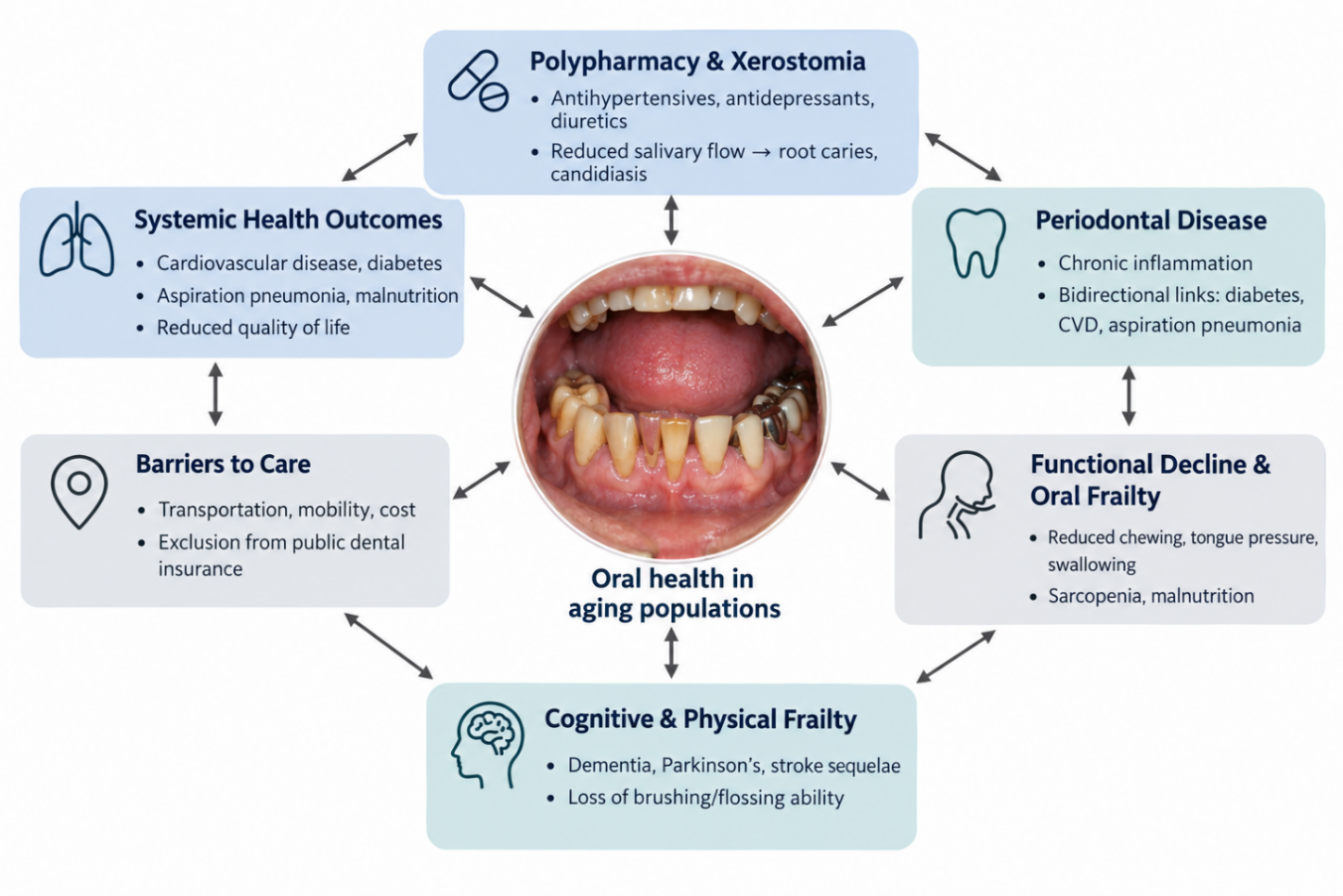
Figure 1. Multifactorial determinants of oral health in aging populations and their bidirectional relationships with systemic health, functional decline, and barriers to care 4.
Warda Abubakar1 | Laiba Rehmat1*
1College of Medicine, Hunan University of Chinese Medicine, Hunan, China *Correspondence: Laiba Rehmat (laiba.rehmat.medicine@gmail.com)
Received: 04 October, 2026; Revised: 18 October, 2026; Accepted: 22 October, 2026; Published: 30 October, 2026
Dental care systems all over the globe are changing as the population is getting older. Retention of natural teeth is greater for older people than for previous generations; however, they are also experiencing an increasing burden of decayed teeth at the root, periodontal disease, problems with oral mucous membranes and dry mouth, and are more likely to have polypharmacy and multimorbidity. This is further complicated by frailty, cognitive impairment, and functional dependence. Oral health is now being associated with systemic impacts such as cardiovascular disease, diabetes, aspiration pneumonia, malnutrition, and quality of life. However, dental care is still not well linked to medical and long-term care, and very few dental practitioners have formal geriatric training. In this editorial, the primary challenges identified in geriatric dentistry include oral changes due to medications, periodontal-systemic interactions, tooth loss, access to care, and shortage of dental professionals. It outlines future research such as the use of non-invasive methods, teledentistry, interprofessional collaboration, and prevention policy change.
Keywords: Oral Health; Geriatric Dentistry; Xerostomia; Periodontal Diseases; Tooth Loss.
The world is aging at an unprecedented pace. According to the World Health Organization estimates that the population of individuals over the age of 60 will be around 2.1 billion by 2050, with the majority of this increase happening in low and middle-income countries 1. This demographic change has been the result of excellent public health, but it is also a challenge for for health professionals, including dentistry. Oral health is not a stand-alone area within the spectrum of general health. It is the basis for nutrition, communication, socialization, and self-esteem 2.Today's older people are keeping more of their natural teeth and, consequently, more teeth for longer at risk of disease. Meanwhile, many suffer from long-term diseases, take several drugs, and require other people to look after them 3. Geriatric dentistry is therefore confronted by a challenging and fast-changing landscape, requiring a change in clinical thinking, education and policy. Figure 1 summarizes the interconnected determinants of oral health in aging populations, which are explored throughout this editorial.
The changing oral disease burden: Increasingly, oral disease has been growing in a different pattern among older adults over the last few decades. The dental condition of complete edentulism is no longer viewed as a normal outcome of aging, and an increasing number of older adults have a functioning dentition into their 80s and 90s in many high-income nations 5. This is a successful example of preventive dentistry and community water fluoridation, but with a cost. Decades of cumulative risk factors such as gingival recession, exposure of tooth surfaces, failing restorations, and recurring decay can be present for retained teeth. Older patients often have heavily restored dentitions that are difficult to maintain and a reduced tolerance for long procedures 6. Regular examination is also important for oral cancer and potentially malignant mucosal disorders, which are increased with age. The clinical treatment of these patients is therefore different than what has been traditionally done, with more teeth, complexity, and vulnerability.
The changing oral disease burden: One of the most pressing problems is dryness of the mouth because of medications. Xerostomia is often seen in older adults; individuals may be taking several medications for high blood pressure, depression, pain, allergies, or urinary problems; many of these medications, such as antihypertensives, antidepressants, anticholinergics, and diuretics, also decrease saliva production 7. The main defense of the mouth is saliva, which neutralizes acid, recoats teeth with minerals, and washes away debris. Its reduction brings swift and drastic consequences. It can cause rapid progression of root caries, an increase in candida, and a decrease in retention and comfort of dentures. Poor dietary choices are also attributed to dry mouth, which also affects the ability to taste, chew, and swallow 8. Although common, xerostomia is often unrecognized because patients accept it as part of aging. Establishment of routine screening, review of medications with physicians, high-fluoride preventive regimens, and saliva substitutes should be an integral part of geriatric dental care.
periodontal disease and systemic interconnections: An increasing number of older people suffer from periodontitis, and the condition is one of the main reasons for tooth loss later in life. It is not only important for the mouth. There is increasing evidence of bidirectional associations between periodontal disease and systemic disease, with attention to diabetes mellitus, where inadequate glycemic control is associated with periodontal destruction, and untreated periodontitis may have a negative impact on metabolic control 9. Other associations have been reported with cardiovascular disease, chronic kidney disease, and rheumatoid arthritis, and may not necessarily be causal. Poor oral hygiene in frail or institutionalized elders leads to colonization of the oropharynx by respiratory pathogens and therewith to a high morbidity and mortality due to aspiration pneumonia 10. These links make periodontal care a medical as well as a dental priority. Dental teams should work in partnership with their doctors to increase the rate of periodontal screening as part of the management of chronic disease pathways, and communicate regularly with their doctors and nursing staff.
Tooth loss, edentulism, and functional decline: Teeth are an important factor in the nutritional status and quality of life of older adults, and tooth loss continues to be a critical factor in the nutritional status of older adults. Those with just a few teeth or poor-fitting dentures are less inclined to eat fibrous fruits and vegetables and protein-rich foods, opting instead for softer, processed, and energy-dense foods 11. This dietary change may lead to sarcopenia, loss of weight, and micronutrient deficiency. The concept of oral frailty has recently been defined as a progressive loss of oral function that includes a decrease in chewing function, tongue pressure, and swallowing ability, and is now regarded as an early indicator of overall physical frailty and the risk of death. Furthermore, oral function can deteriorate without signs of clinical disease 12. Well-designed removable and implant-supported prostheses are effective for restoring function following tooth loss; however, their application must account for the patient's dexterity, cognition, and financial resources. Measures in the design of prosthesis plans for older adults should be taken for maintainability and comfort, not just an idealistic look.
Frailty, cognitive decline, and barriers to care: Perhaps the most difficult challenge is delivering care to those who cannot easily reach it. For older persons with dementia, stroke sequelae, Parkinson's disease, or severe arthritis, it may be difficult to brush or floss adequately, and they may be hesitant to accept help or assistance due to fear, confusion, or discomfort 13. Long-term care residents are particularly at risk, since oral care is frequently overlooked in the context of competing nursing responsibilities. Issues of transportation challenges, mobility, and costs also narrow access, especially if dental care for adults is not covered by public insurance. Older people often only present to the health care provider when the pain or signs of infection are intolerable, at which point options for treatment are limited 14. These obstacles need to be solved through domiciliary services, training of the caregivers in daytime oral care, simplified oral hygiene measures, and ethical considerations of consent and decision-making when capacity is reduced.
Workforce, education, and health system gaps: A primed dental workforce for the geriatric complexity is necessary to meet these needs, and there is limited geriatric training in many dental curricula. Dental students get only a "quick" introduction to gerontology, medically complex patients, or managing cognitive impairment; graduates are not certain when they treat frail elders in these relative areas of dental study 15. Dental care is also often isolated from medical data, dental records, and long-term dental care planning, tarnishing the patient experience and compromising important risks. The systems of reimbursement usually favor procedures and not prevention or more time-consuming geriatric consultation, which is a disincentive to practitioners serving this population 16. Closing these gaps would be facilitated through the reinforcement of gerontology content in undergraduate and postgraduate programmes, through the creation of recognition for specialists, and by extending the role of the dental hygienist and community health worker. Interprofessional learning, involving medical, dental, nursing and pharmacy students learning together, can support the development of a team working approach needed by older people Figure 1.
Figure 1. Multifactorial determinants of oral health in aging populations and their bidirectional relationships with systemic health, functional decline, and barriers to care 4.
There are a couple of things that seem promising. Minimally invasive dentistry, such as silver diamine fluoride, resin infiltration, atraumatic restorative techniques are well suited for frail patients due to the reduced amount of seat time and reduced anxiety required to deal with these procedures. Teledentistry and portable equipment can help to expand screening and triage to care homes and rural areas, and artificial intelligence may aid in earlier identification of caries, periodontal bone loss, and oral lesions. Salivary diagnostics and individual risk assessment can result in prevention plans specific to the individual patient's record. Innovation of policy is also essential, for example, providing older people access to dental services through public health plans, making oral health indicators part of healthy ageing policies, as well as embedding oral screening into primary care consultations. Need for the research to be pragmatic, in older and cognitively impaired population, often under-represented in studies, for informed clinical practice.
Oral health must not be taken for granted as people grow older. It's a variable aspect of nutrition, systemic health, communication, and dignity. They also face a more complex dentate population, medication-related dry mouth, declining function, limited access to care, and a workforce that is not adequately prepared, while interactions between periodontal health and the wider body add further challenges. These factors are easily controlled but not too difficult. To make progress, preventive thinking and integrated dental-medical care, and improved geriatric education and supportive public policies are required. Profession and health systems taking action now, longer lives can be healthier and happier; older people can eat, talk, smile and feel confident.
This work is published by Multidisciplinary Scholarly Advancement and Research MSAR Institute. © 2026 The Author(s). The full terms of Journal Publishing policies are available at https://msarjournals.com/index.php/index/open-access and incorporate the Creative Commons Attribution – Non Commercial (CC BY-NC 4.0) License https://creativecommons.org/licenses/by-nc/4.0/. By accessing the work you hereby accept the Terms. Non-commercial uses of the work are permitted without any further permission, provided the work is properly attributed. Publisher’s Note: MSAR Institute remains neutral with regard to jurisdictional claims in published maps and institutional affiliations, and assumes no liability for the scientific accuracy or clinical efficacy of the content herein, as they rest entirely with the authors.