Factors Associated with Delayed Eye Examination Among Diabetic Patients: A Cross-Sectional Study
DOI:
https://doi.org/10.68041/medsc.v1i1/05Keywords:
Diabetes Mellitus, Diabetic Retinopathy, Health Services Accessibility, Risk Factors, Vision ScreeningAbstract
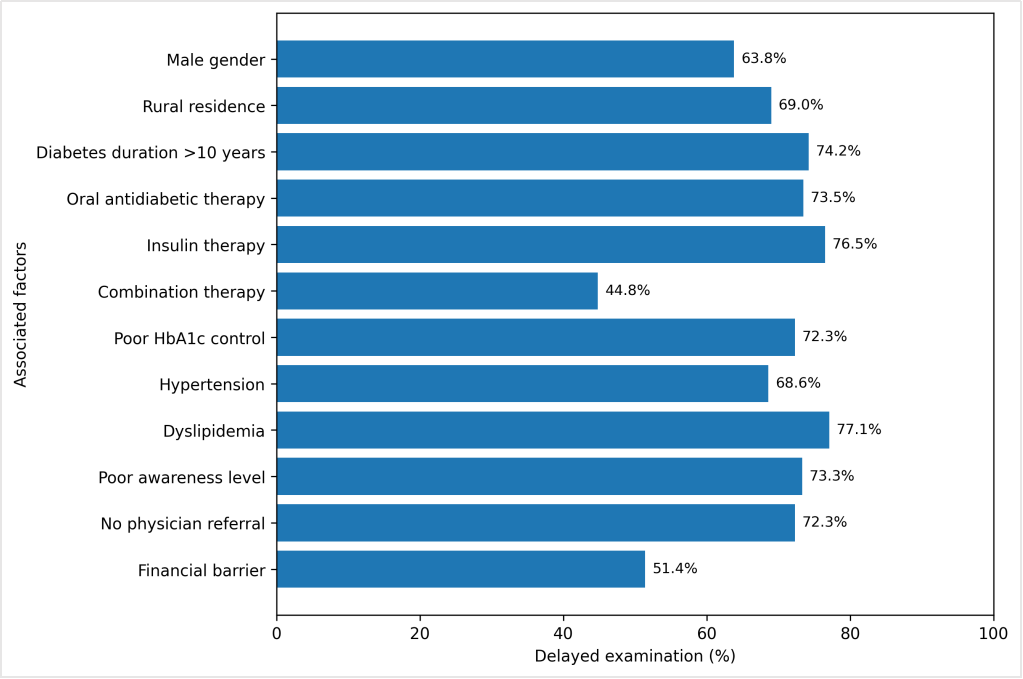
Background: Failure to get an eye exam early is a major obstacle in preventing and detecting diabetic eye diseases. This study aimed to assess the prevalence of undergoing delayed eye examination and to identify other demographic, clinical, and healthcare-related factors associated with such delayed eye examination among diabetic patients. Methods: A cross-sectional analytical study was conducted in the Diabetes Clinic and Ophthalmology Department of a tertiary care teaching hospital between January and June, 2022, enrolling 80 diabetic patients. A structured questionnaire and clinical data collection form were used to collect data on socio-demographic characteristics, diabetes related factors, awareness about diabetic eye disease, and healthcare accessibility factors. A chi-square test was performed to see if there were any associations between potential predictors and delayed eye examination, and a multivariable logistic regression analysis was conducted. Results: 51(63.8%) participants had a delayed eye examination, while 29(36.3%) had a timely eye examination. A total of 45(56.3%) participants had poor awareness of the diabetic eye complications. There was a significant association between treatment modality and delayed examination (p=0.029) and a borderline association between dyslipidemia and delayed examination (p=0.050). Multivariable analysis showed that insulin therapy was independently associated with delayed eye examination (AOR=5.94, 95% CI: 1.31–26.91, p=0.021). Conclusion: Diabetic patients were more likely to be late for their eye exams, reflecting a lack of preventive diabetic eye care. Awareness and referral systems should be improved for early detection. Multi-center research is needed to assess strategies to improve screening adherence.
References
1. Hashemi H, Rezvan F, Pakzad R, Ansaripour A, Heydarian S, Yekta A, et al. Global and regional prevalence of diabetic retinopathy: A comprehensive systematic review and meta-analysis. Semin Ophthalmol. 2022;37(3):291-306. https://doi.org/10.1080/08820538.2021.1962920
2. Wei L, Sun X, Fan C, Li R, Zhou S, Yu H. The pathophysiological mechanisms underlying diabetic retinopathy. Front Cell Dev Biol. 2022;10(1):963615. https://doi.org/10.3389/fcell.2022.963615
3. Widyaputri F, Rogers SL, Kandasamy R, Shub A, Symons RC, Lim LL. Global estimates of diabetic retinopathy prevalence and progression in pregnant women with preexisting diabetes: a systematic review and meta-analysis. JAMA Ophthalmol. 2022;140(5):486-94. https://doi.org/10.1001/jamaophthalmol.2022.0050
4. Ravindranath R, Bernstein IA, Fernandez KS, Ludwig CA, Wang SY. Social determinants of health and perceived barriers to care in diabetic retinopathy screening. JAMA Ophthalmol. 2023;141(12):1161-1171. https://doi.org/10.1001/jamaophthalmol.2023.5287
5. Malik MB, Chippa SA, Rashid A, Akram S. Awareness and referral attitudes of diabetic retinopathy among surgeons at a tertiary care hospital in Pakistan. Pak J Ophthalmol. 2023;39(3):189-194. https://doi.org/10.36351/pjo.v39i3.1553
6. Heiran A, Azarchehry SP, Dehghankhalili S, Afarid M, Shaabani S, Mirahmadizadeh A. Prevalence of diabetic retinopathy in the Eastern Mediterranean Region: a systematic review and meta-analysis. J Int Med Res. 2022;50(10):03000605221117134. https://doi.org/10.1177/03000605221117134
7. Achigbu EO, Onyia OE, Oguego NC, Murphy A. Assessing the barriers and facilitators of access to diabetic retinopathy screening in sub-Saharan Africa: A literature review. Eye (Lond). 2024;38(11):2028-2035. https://doi.org/10.1038/s41433-023-02673-y
8. Das T, Takkar B, Sivaprasad S, Thanksphon T, Taylor H, Wiedemann P, et al. Recently updated global diabetic retinopathy screening guidelines: Commonalities, differences, and future possibilities. Eye (Lond). 2021;35(10):2685-2698. https://doi.org/10.1038/s41433-021-01572-4
9. Bujang MA. An elaboration on sample size planning for performing a one-sample sensitivity and specificity analysis by basing on calculations on a specified 95% confidence interval width. Diagnostics (Basel). 2023;13(8):1390. https://doi.org/10.3390/diagnostics13081390
10. Yim D, Chandra S, Sondh R, Thottarath S, Sivaprasad S. Barriers in establishing systematic diabetic retinopathy screening through telemedicine in low- and middle-income countries. Indian J Ophthalmol. 2021;69(11):2987-2992. https://doi.org/10.4103/ijo.IJO_1411_21
11. Rahmati M, Smith L, Boyer L, Fond G, Yon DK, Lee H, et al. Factors affecting global adherence for the uptake of diabetic retinopathy screening: A systematic review and meta-analysis. Am J Ophthalmol. 2024;268(1):94-107. https://doi.org/10.1016/j.ajo.2024.07.028
12. Gupta P, Gan ATL, Man REK, Fenwick EK, Sabanayagam C, Mitchell P, et al. Impact of knowledge and awareness on diabetic retinopathy screening practices among people with diabetes: A systematic review. Surv Ophthalmol. 2022;67(5):1235-1248. https://doi.org/10.1016/j.survophthal.2022.01.004
13. Prothero L, Cartwright M, Lorencatto F, Burr JM, Anderson J, Gardner P, et al. Barriers and enablers to diabetic retinopathy screening: A cross-sectional survey of young adults with type 1 and type 2 diabetes in the UK. BMJ Open Diabetes Res Care. 2022;10(6):e002971. https://doi.org/10.1136/bmjdrc-2022-002971
14. Lawrenson JG, Graham-Rowe E, Lorencatto F, Burr JM, Bunce C, Francis JJ, et al. Interventions to increase attendance for diabetic retinopathy screening. Cochrane Database Syst Rev. 2023;4(4):CD012054. https://doi.org/10.1002/14651858.CD012054.pub3
15. Egunsola O, Dowsett LE, Diaz R, Brent MH, Rac VE, Clement FM. Diabetic retinopathy screening: A systematic review of qualitative literature. Can J Diabetes. 2021;45(8):725-733.e12. https://doi.org/10.1016/j.jcjd.2021.01.014
16. Curran K, Piyasena MMPN, Congdon N, Duke L, Malanda B, Peto T, et al. Inclusion of diabetic retinopathy screening strategies in national-level diabetes care planning in low- and middle-income countries: A scoping review. Health Res Policy Syst. 2023;21(1):2. https://doi.org/10.1186/s12961-022-00940-0
17. Zikhali T, Kalinda C, Xulu-Kasaba ZN. Screening of diabetic retinopathy using teleophthalmology to complement human resources for eye health: A systematic review and meta-analysis. Clin Pract (Basel). 2022;12(4):457-467. https://doi.org/10.3390/clinpract12040050
18. Lin KY, Hsih WH, Lin YB, Wen CY, Chang TJ. Update in the epidemiology, risk factors, screening, and treatment of diabetic retinopathy. J Diabetes Investig. 2021;12(8):1322-1325. https://doi.org/10.1111/jdi.13480
19. Teo ZL, Tham YC, Yu M, Chee ML, Rim TH, Cheung N, et al. Global prevalence of diabetic retinopathy and projection of burden through 2045: Systematic review and meta-analysis. Ophthalmology. 2021;128(11):1580-1591. https://doi.org/10.1016/j.ophtha.2021.04.027
20. Weerasinghe LS, Dunn HP, Fung AT, Maberly G, Cheung NW, Weerasinghe DP, et al. Diabetic retinopathy screening at the point of care (DR SPOC): Detecting undiagnosed and vision-threatening retinopathy by integrating portable technologies within existing services. BMJ Open Diabetes Res Care. 2023;11(4):e003376. https://doi.org/10.1136/bmjdrc-2023-003376
21. Rajesh AE, Davidson OQ, Lee CS, Lee AY. Artificial intelligence and diabetic retinopathy: AI framework, prospective studies, head-to-head validation, and cost-effectiveness. Diabetes Care. 2023;46(10):1728-1739. https://doi.org/10.2337/dci23-0032
22. Taris TW, Kessler SR, Kelloway EK. Strategies addressing the limitations of cross-sectional designs in occupational health psychology: What they are good for (and what not). Work Stress. 2021;35(1):1-5. https://doi.org/10.1080/02678373.2021.1888561
Downloads
Published
Issue
Section
License
Copyright (c) 2026 Aliya Ameen, Shanza Akram (Author)

This work is licensed under a Creative Commons Attribution-NonCommercial 4.0 International License.
MSAR Medical Sciences (MSAR MS) follows the Attribution Creative Commons-Non commercial (CC BY-NC 4.0) license which allows the users to copy and redistribute the material in any medium or format, remix, transform and build upon the material. The users must give credit to the source and indicate, provide a link to the license, and indicate if changes were made. However, the CC BY-NC 4.0 license restricts the use of material for commercial purposes (Further details are available at website. The Editorial Board of the MSAR MS endeavors to ensure the accuracy, integrity, and quality of all published content. However, the responsibility of opinions, interpretations, and conclusions expressed in the published articles rests entirely with the authors and do not necessarily reflect the views of the Editorial Board, publisher, or affiliated institutions.