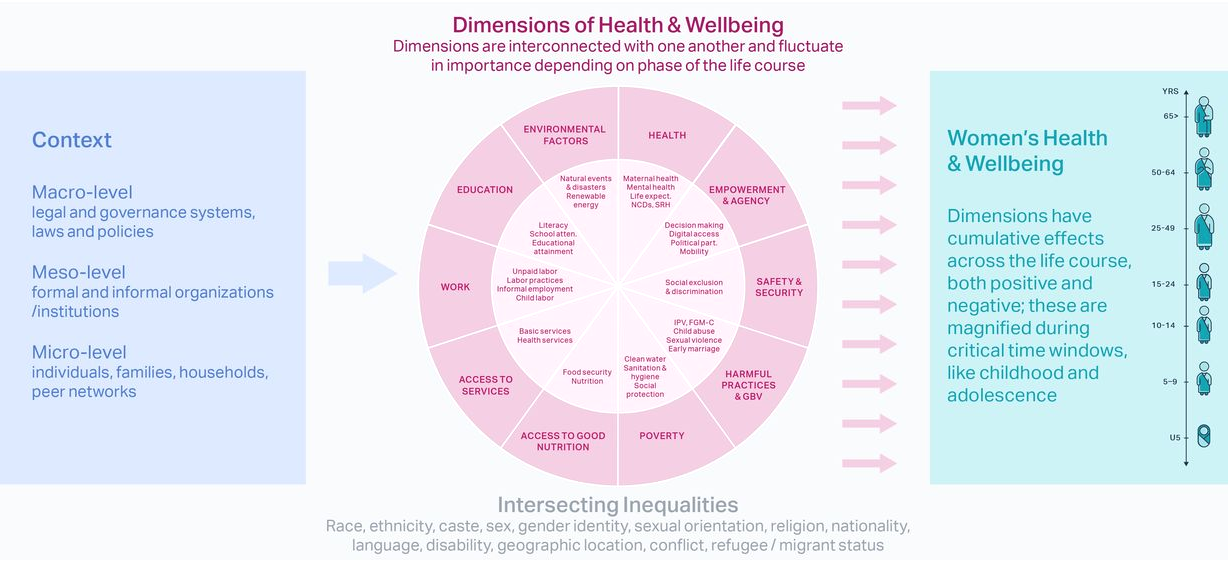
Figure 1. Dimensions of women’s health and well-being across the life course, illustrating the influence of macro-, meso-, and micro-level contexts, intersecting inequalities, and cumulative effects across different life stages 29.
Muhammad Ehsan1
1Allied Health Sciences, Shaikh Zayed Hospital, Lahore, Pakistan *Correspondence: Muhammad Ehsan (ahspreparations512@gmail.com)
Received: 04 October, 2026; Revised: 18 October, 2026; Accepted: 24 October, 2026; Published: 30 October, 2026
Women's health is not limited to women's reproductive health, but health systems are typically structured around discrete reproductive events and/or disease-specific services. A life-course perspective, however, acknowledges the interplay between biological transitions, cumulative exposures, social contexts, and evolving health and healthcare needs from adolescence to older age. This editorial offers an overall model of Women's Health (the Women's Health Continuum Model) comprised of five interrelated functions: prevention, early detection, transition care, integrated management, and longitudinal follow-up. It also brings to the forefront the recognition of the interrelationships of cardiometabolic, mental, neurological, musculoskeletal, cancer, sexual, and pelvic health as areas of women's health and not distinct clinical specialties. Attention will need to be paid to socioeconomic conditions, geographic access, health literacy, caregiving responsibilities, disability, gender-related barriers, violence, and representation in research to implement equitably. Health trajectory-based care can enhance prevention, continuity, and more comprehensive and patient-centered care throughout the lifespan.
Keywords: Aging; Chronic Disease; Health Equity; Life Cycle Stages; Patient-Centered Care; Preventive Health Services; Women's Health.
Women’s health has long been discussed through a predominantly reproductive lens, with substantial attention directed toward pregnancy, contraception, fertility, and maternal care. These areas represent only one component of women's health. As women go through adolescence, adulthood, menopause, and older age, they have their unique health needs, such as cardiac, metabolic, neurological, musculoskeletal, mental, and other chronic conditions 1-3. A more inclusive definition is therefore required that takes a wider view of women's health and considers it to be a life course experience rather than a series of reproductive events. A life-course perspective emphasizes the interplay of the biological, social, environmental and behavioural exposures throughout the life course and the impact that experiences in early life may have on later life health outcomes 4.
This approach is about recognising and understanding opportunities for prevention and periods of vulnerability, where clinical intervention could have an impact on longer-term outcomes. Recent evidence has also pointed to the burden of disease among women being much more than just reproductive. Sex-specific differences in disease burden are substantial across the lifespan, and cardiovascular diseases, cancers, mental health, and other noncommunicable diseases significantly drive disease burden affecting women 2,3.The challenge, therefore, is not to move reproductive health aside, but to place it within a more comprehensive framework of lifelong women's health. A framework that can link reproductive events to a larger biological and social trajectory, allowing pregnancy, menstruation, menopause, and other events to offer better opportunities for prevention and long-term health assessments, rather than standalone clinical events4,5
Women’s health trajectories are shaped well before pregnancy or other reproductive events. Childhood nutrition, physical health and growth, physical activity, mental health, socioeconomic status, and exposure to the environment may impact health risks that carry over into adulthood. Adolescence is thus a critical time for catching up on good health habits and early signs and symptoms of metabolic, psychological, menstrual, and reproductive health problems6,7. An irregular menstrual cycle can also be an early indicator of broader health problems. Irregular periods can last long with other endocrine and metabolic disorders, eating disorders, an excessive level of physical activity, or polycystic ovary syndrome. Identifying these patterns at the adolescent stage can provide opportunities to assess these issues earlier than they would ordinarily be considered reproductive problems8. Device-associated infections also warrant attention when evaluating perioperative safety. A study of catheter-associated urinary tract infections in hospitalized patients identified multidrug-resistant organisms as an important concern, highlighting the need for appropriate catheter use, infection-prevention practices, and antimicrobial stewardship. Such infections should be considered alongside other preventable complications when assessing the quality of hospital care9.
The onset of adulthood is also a time to correct the modifiable risk factors like obesity, smoking, lack of exercise, eating poorly, and mental health problems. These factors may be important to future cardiovascular and metabolic health and can also impact future pregnancy outcomes6.Thus, a life course perspective changes the focus of prevention from prevention of the onset of clinical disease to the promotion of health. Healthcare shouldn't only focus on preparing for future reproductive events when caring for young people and adolescents, but should help build a wider base for cardiovascular, metabolic, mental, reproductive and musculoskeletal health. This provides an important starting point for the continuous health trajectory proposed in this editorial.
Transitions as Opportunities for Prevention:Major transitions in women’s lives are often treated as separate clinical episodes, although they can provide important opportunities to reassess health and anticipate future risk. Significant biological and psychosocial changes occur during adolescence, pregnancy, postpartum, perimenopause, and menopause, which may uncover previously undiagnosed problems or change the long-term disease risk10,11.Pregnancy complications can affect both maternal and offspring health. They can also identify women at increased risk of subsequent cardiovascular and metabolic disease and may be able to offer postpartum risk assessment and prevention services as opposed to a conclusion of postpartum management once the delivery is over12,13.
Menopause as a clinical transition:Menopause similarly represents more than the management of vasomotor or genitourinary symptoms. Cardiometabolic health, bone health, sleep, mood, and sexual health can all change as women enter menopause. By acknowledging menopause as a continuum of health care, health professionals can work on these areas as a whole, instead of symptom-by-symptom interventions14.Therefore, life-course models should focus on clinical checkpoints, which are key transitions. These intervals may be used for a re-evaluation of risk, re-emphasis of prevention, and follow-up of diseases that are likely to have an impact on health in the future. This way, reproductive experiences are linked to overall health, but not to the extent of making women's health synonymous with reproduction.
Women’s health should not be understood as a sequence of unrelated clinical episodes. Risk factors and biological changes may build up over the lifespan, and early exposures may predispose a person to risk of disease in adulthood. Adverse childhood experiences, socioeconomic disadvantage, obesity, smoking, physical inactivity and other exposures might lead to patterns of cardiovascular, metabolic and mental health issues15,16. Reproductive events may also be used as indicators of health in later life. Complications of pregnancy, such as hypertension and gestational diabetes, can help to identify women at higher long-term risk of cardiometabolic disease17.Their implications are therefore more than just for the pregnant woman and provide a chance to set up preventative follow-up.
A life-course perspective also recognizes that health trajectories can extend across generations. In addition to other factors, maternal nutrition, metabolic health, and pregnancy complications have the potential to affect the outcome of pregnancy and health risks in the offspring. This serves as a reminder to link maternal, reproductive, and chronic disease prevention as a whole, not as separate services18. Experimental studies have also linked intrauterine chromium restriction and prenatal bisphenol A exposure with metabolic and epigenetic alterations in offspring26,27.The practical implication is a shift from episode-based risk assessment to trajectory-based risk assessment. Clinicians should use a woman's past health history to anticipate future risks and tailor preventive strategies before disease becomes clinically apparent.
Cardiovascular disease, hypertension, diabetes, and obesity are also significant drivers of disease burden in women, and these conditions are also routinely treated independently of reproductive and menopausal conditions 3,17. Research in postmenopausal women has also examined the relationship between body mass index, lipid profiles, and cardiovascular disease, illustrating the relevance of cardiometabolic assessment beyond the reproductive years19. There is also a need to address depression, anxiety, migraine, and cognitive changes throughout the lifespan. The interrelationship between mental and neurological health issues and aspects of hormonal transitions, chronic disease, social factors, and ageing is easily overlooked, and often treated through separate clinical pathways20.A more comprehensive approach should integrate mental and neurological health into the care of women's health rather than as a secondary issue. It is well known that with ageing, bone health, osteoporosis, fracture, sarcopenia, and chronic pain become more relevant, especially during perimenopause and post menopause. Menopausal changes can affect bone health and other aspects of physical health, creating an opportunity to integrate preventive care, physical activity, nutrition, and appropriate risk assessment into women's routine care11,14.
Breast, cervical, ovarian, and endometrial cancers are examples of the need for prevention and detection across the life course. Avoidance and screening are important aspects of comprehensive women's health and not just a specialty service, as they are part of the cancer risk factors, including age, reproductive history, genetics, metabolic factors, and environmental exposures21. Pelvic-floor disorders, urinary symptoms, sexual dysfunction and genitourinary conditions may continue or develop after the reproductive years. Women's health care is often planned around reproductive issues, with the result that these concerns can have significant impact on women's quality of life but may not be fully recognised. Improving routine care for sexual health and pelvic health would help to meet the needs of sexual and pelvic health throughout reproductive and post-reproductive life4,5. The problem is therefore not the absence of individual specialties; it is the absence of continuity between them. A woman can seamlessly navigate from reproductive care to cardiology, mental health, oncology, and musculoskeletal care while having a broader health care journey overlooked. Reimagining women's health involves linking these dimensions around the person and not just around individual diseases.
There is more to a life-course approach than simply putting services together for various age groups; it is a way of re-organising the way those services are linked together. The WHO framework places importance on continuity throughout the life cycle and coordination around the evolving health needs1. Likewise, to achieve a life-course approach to women's health, prevention and care should not be limited to reproductive services and should encompass noncommunicable diseases and other conditions in adulthood. For women, this can be translated into a Women’s Health Continuum Model built around five interconnected functions. Prevention should start before the disease is clinically apparent. Life-stage assessment can provide opportunities to address modifiable risk factors for cardiovascular, metabolic, mental, reproductive, and musculoskeletal health and risks before major life changes occur3,5. Screening and risk assessment should be adapted to individual risk and life stage rather than relying on age alone. Routine meetings may be leveraged to detect potential new risks and to start follow-up activities. One example of services that can be combined into an integrated pathway is reproductive or preconception care, which includes prevention, health promotion, and early identification of risk22.
Pregnancy should be viewed as a clinical marker to review past health and render a new assessment of risk, as should postpartum, perimenopause, and menopause. For instance, opportunities for prevention of cardiovascular and metabolic outcomes exist with pregnancy-related hypertension and glucose abnormalities that may signal increased long-term cardiovascular and metabolic risk12,13. Placental expression of genes involved in vitamin D metabolism has also been associated with spiral artery remodeling in women with preeclampsia, highlighting the relevance of placental biology to pregnancy-related health assessment28. Care should connect reproduction, cardiovascular, metabolic, mental, musculoskeletal, and cancer care-related needs rather than treating them as isolated domains. There is evidence of continuity and care coordination, including connecting services across phases of illness and between the different settings of care, and that a multidisciplinary and integrated approach helps to maintain continuity over the life course23.
Clinically relevant information should be conveyed to the patient throughout the stages of life. Previously encountered pregnancy issues, menstruation, metabolic risk, menopause, family history, and other factors should guide future prevention decisions, and should not be evaluated as separate events14.This changes women's healthcare from episodic disease management to longitudinal health stewardship. Women's health and well-being are shaped by interconnected biological, social, environmental, and structural dimensions operating across different levels of context, with cumulative effects throughout the life course and during critical developmental periods Figure 1 29.
Figure 1. Dimensions of women’s health and well-being across the life course, illustrating the influence of macro-, meso-, and micro-level contexts, intersecting inequalities, and cumulative effects across different life stages 29.
A life-course model will remain incomplete if it does not address who can access and benefit from care. Biological transitions are not the only factors that affect women's health; economic, social, geographic, education, health literacy, disability, caregiving, and exposure to violence also play important roles in women's health16,24. These factors can affect women's access to preventive services, timely diagnosis, prompt treatment, and follow-up. These factors can create barriers to preventive services, timely diagnosis, treatment, and longitudinal follow-up, particularly where healthcare systems are difficult to access or poorly adapted to women's social circumstances.
Availability and affordability of healthcare services, as well as responsiveness of health systems to different social and cultural contexts, also affect access to healthcare23,24. Meanwhile, low participation of women in clinical trials may reduce the quality and effectiveness of evidence to inform their treatment. Therefore, strategies to enhance women's participation in clinical trials are important in order to build evidence that better represents the women who receive treatment25. A meaningful life-course framework must therefore combine clinical continuity with equitable access, representative evidence, and patient-centred care. The intention is not to establish a further tier of specialist services but to make sure that the current service pathways are aware of the woman's situation in addition to her clinical history.
Women's health should move beyond a reproductive focus to a more comprehensive approach that acknowledges the varying needs of women throughout their lives, cumulative risks, significant life transitions, and opportunities for prevention. Reproductive care is important, but it needs to be linked to cardiovascular, metabolic, mental, musculoskeletal, neurological, cancer, sexual, and pelvic health throughout the lifespan. The continuum proposed moves from isolated clinical episodes toward prevention, early detection, transition-focused assessment, integrated management, and longitudinal follow-up. The goal is not to place reproductive health at the margins, but to position it within a broader framework in which every stage of a woman's life becomes an opportunity to maintain health, identify risk, and prevent disease.
This work is published by Multidisciplinary Scholarly Advancement and Research MSAR Institute. © 2026 The Author(s). The full terms of Journal Publishing policies are available at https://msarjournals.com/index.php/index/open-access and incorporate the Creative Commons Attribution – Non Commercial (CC BY-NC 4.0) License https://creativecommons.org/licenses/by-nc/4.0/. By accessing the work you hereby accept the Terms. Non-commercial uses of the work are permitted without any further permission, provided the work is properly attributed. Publisher’s Note: MSAR Institute remains neutral with regard to jurisdictional claims in published maps and institutional affiliations, and assumes no liability for the scientific accuracy or clinical efficacy of the content herein, as they rest entirely with the authors.