| Source | n | % |
|---|---|---|
| Healthcare professionals | 76 | 43.4 |
| Social media/internet | 51 | 29.1 |
| Television/radio | 21 | 12.0 |
| Friends/family | 17 | 9.7 |
| Educational programs | 10 | 5.7 |
There was a steady rise in the level of awareness from 10(32.3%) of women with primary education or below to 40 (83.3%) of graduates or above. There was a statistically significant (p<0.001) correlation between education level and awareness, as shown in Table 5.
Table 5: Awareness According to Educational Level
| Education | Adequate Awareness n (%) | Poor Awareness n (%) |
|---|---|---|
| Primary or below | 10 (32.3) | 21 (67.7) |
| Secondary | 28 (49.1) | 29 (50.9) |
| Intermediate | 25 (64.1) | 14 (35.9) |
| Graduate or above | 40 (83.3) | 8 (16.7) |
| p-value | <0.001 |
Adequate awareness increased progressively with higher educational level, rising from 32.3% among women with primary education or below to 83.3% among graduates or above Figure 1. The association between educational level and awareness was statistically significant (p<0.001).
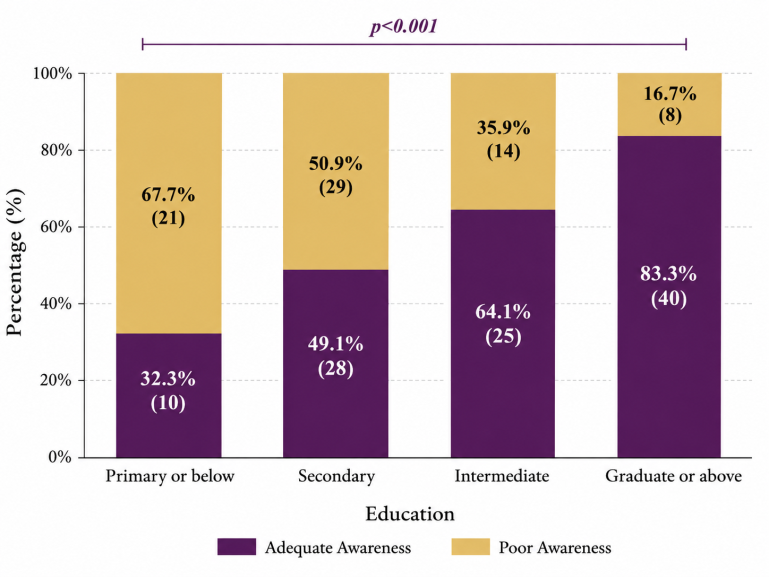
Figure 1: Awareness level according to educational attainment.
Previous knowledge of screening information exposure, graduate education, and prior gynecological consultation showed a significant association with adequate awareness (AOR=3.16, 95% CI: 1.61–6.19; AOR=3.84, 95% CI: 1.72–8.57; and AOR=2.47, 95% CI: 1.25–4.88, respectively). Age >40 years was not significantly associated with awareness (AOR=1.42, 95% CI: 0.76–2.67; p=0.268), as shown in Table 6.
Table 6: Factors Associated with Adequate Screening Awareness
| Factor | Adjusted OR | 95% CI | |
|---|---|---|---|
| Graduate education or above | 3.84 | 1.72–8.57 | 0.001 |
| Previous gynecological consultation | 2.47 | 1.25–4.88 | 0.009 |
| Previous exposure to screening information | 3.16 | 1.61–6.19 | 0.001 |
| Age >40 years | 1.42 | 0.76–2.67 | 0.268 |
Discussion
The present study revealed a satisfactory awareness of cervical cancer screening among 58.9% of the women attending the gynecology clinics. The recognition of Pap smear was high (69.1%), but awareness of HPV testing (38.9%) and screening without symptoms (47.4%) was significantly lower. Therefore, knowledge of screening was not synonymous with knowing all the current screening methods. Among women, a similar level of adequate knowledge was reported in a study with 59.4% 14. Comparable findings were reported in a study where 67.5% of women had heard of cervical cancer and 50.9% were aware of Pap smear testing, although only 13.4% demonstrated a high level of cervical cancer knowledge 15.
The percentage of Pap smear awareness in the present study (69.1%) was higher than that reported among Saudi women in Al Madinah (44.6%) and adult Saudi women in another study (59.9%) 16,17. However, educated North Indian females were found to have good knowledge of Pap smear and HPV vaccination as compared to approximately three-quarters of educated North Indian females 18. The low levels of HPV-test awareness found in this study suggest that there are still a significant proportion of women who may view cervical screening primarily as a cytology test. Thai women who were referred post abnormal screening had also limited detailed knowledge, as 26.9% and 20.1% had good HPV and screening knowledge, respectively 19. Current or past smoking was independently linked to an advanced stage of presentation (AOR=2.94) 21. Among women referred post abnormal screening, only 26.9% and 20.1% had good HPV and screening knowledge, respectively. Recently, Kuwaiti researchers have also reported that only 55% of women were aware that HPV was a risk factor for cervical cancer 20. Similar disparities highlight the need to maintain HPV knowledge at or below the level of awareness of general screening.
There was a strong association between education and awareness (ranging from 32.3% for primary education or less compared to 83.3% for graduates), with the latter independently predicting awareness. The same was seen in Omani research, which showed a highly significant correlation between education and knowledge about cervical cancer 21. A study in a health center in Greece also showed that education was independently related to awareness of the cervical screening program 22. A large US study found that social-media users were more likely to be aware of HPV and HPV vaccination, supporting the potential role of digital information sources in improving HPV-related awareness 23. Furthermore, an educational trial in primary care showed an increase in HPV and screening knowledge following a patient-centered digital intervention, which suggests that structured education during a clinic visit is effective 24.
Adequate awareness was independently associated with having been previously referred to a gynaecologist, suggesting that contact with reproductive health services may be an important opportunity for providing reproductive health education. However, a study conducted in an Omani tertiary clinic showed that although 86% had heard of cervical cancer and 55% had heard of Pap testing, only 26% had adequate knowledge 25. Likewise, 49.5% of the patients who came to the gynecology clinic were aware of Pap screening, while low education status was another significant barrier 26. These findings have been further supported by uniform counselling in eligibility for screening, HPV testing, and follow-up for women in well-woman visits in 2025 in a two-arm randomized trial, which revealed that structured health education significantly enhanced awareness and screening uptake 27.
There are few limitations in this study, such as a cross-sectional design that does not allow for the interpretation of any causal relationship between variables (education, contact with healthcare, information exposure and awareness). The results might not be generalizable to women who do not have access to health care, and the responses to the questions might be subject to recall or social-desirability bias. Further multicenter longitudinal studies should involve community members, test awareness tools, and establish the relationship between awareness and screening in accordance with guidelines.Conclusion
The findings from this study showed that the awareness of cervical cancer screening was satisfactory among women attending gynecology clinics, that is 58.9%, better in the recognition of pap smear than HPV and screening for asymptomatic women. Awareness was significantly linked to higher education, prior gynecological consultation, and prior exposure to screening information. The results indicate that using a clinic-based education approach was a crucial step in increasing informed participation in cervical cancer screening. Targeted educational interventions and impact on real-life screening uptake among different population groups should be assessed in future studies.
References
- Li Z, Liu P, Yin A, Zhang B, Xu J, Chen Z, et al. Global landscape of cervical cancer incidence and mortality in 2022 and predictions to 2030: The urgent need to address inequalities in cervical cancer. Int J Cancer. 2025;157(2):288-297. https://doi.org/10.1002/ijc.35369
- Gupta R, Singh S, Gupta S. Performance characteristics of the point-of-care tests for HPV-based cervical cancer screening: a systematic review and meta-analysis. J Public Health (Oxf). 2025;47(1):e106-e115. https://doi.org/10.1093/pubmed/fdae306
- Terasawa T, Hosono S, Sasaki S, Hoshi K, Hamashima Y, Katayama T, et al. Comparative accuracy of cervical cancer screening strategies in healthy asymptomatic women: a systematic review and network meta-analysis. Sci Rep. 2022;12(1):94. https://doi.org/10.1038/s41598-021-04201-y
- Canfell K, Kim JJ, Brisson M, Keane A, Simms KT, Caruana M, et al. Mortality impact of achieving WHO cervical cancer elimination targets: a comparative modelling analysis in 78 low-income and lower-middle-income countries. Lancet. 2020;395(10224):591-603. https://doi.org/10.1016/S0140-6736(20)30157-4
- Farajimakin O. Barriers to cervical cancer screening: A systematic review. Cureus. 2024;16(7):e65555. https://doi.org/10.7759/cureus.65555
- Patel AM, Peters SG. Clinical manifestations of lung cancer. Mayo Clin Proc. 1993;68(3):273–277. https://doi.org/10.1016/S0025-6196(12)60049-4
- Appiah RS, Boakye K, Appiah G, Aidoo AA, Acquah-Hagan G, Singh B, et al. Rural-urban variations in cervical cancer screening uptake among women in Ghana: Evidence from the 2022 Ghana Demographic and Health Survey. BMC Womens Health. 2025;25(1):255. https://doi.org/10.1186/s12905-025-03802-3
- MacLaughlin KL, Jenkins GD, St Sauver J, Fan C, Miller NE, Meyer AF, et al. Primary human papillomavirus testing by clinician- versus self-collection: Awareness and acceptance among cervical cancer screening-eligible women. J Med Screen. 2024;31(4):223-231. https://doi.org/10.1177/09691413241260019
- Riaz L, Manazir S, Jawed F, Ali SA, Riaz R. Knowledge, perception, and prevention practices related to human papillomavirus-based cervical cancer and its socioeconomic correlates among women in Karachi, Pakistan. Cureus. 2020;12(3):e7183. . https://doi.org/10.7759/cureus.7183
- Sharif M, Majeed HK, Tagar K, Lohana S, Rauf A, Sharif M, et al. Reproductive health-related knowledge, attitude, and practices in women of reproductive age in underdeveloped areas of Punjab, Pakistan. Cureus. 2022;14(11):e31043. https://doi.org/10.7759/cureus.31043
- Rana T, Chan DNS, Law BMH, Choi KC, Shrestha S, So WKW. Determinants of cervical cancer screening utilisation among women in the least developed countries: A systematic review and meta-analysis. PLoS One. 2025;20(6):e0321627. https://doi.org/10.1371/journal.pone.0321627
- Zhang M, Sit JWH, Chan DNS, Akingbade O, Chan CWH. Educational interventions to promote cervical cancer screening among rural populations: A systematic review. Int J Environ Res Public Health. 2022;19(11):6874. https://doi.org/10.3390/ijerph19116874
- Kolambkar S, Tomar M, Arif N, Hussain S, Gupta E, Singh S. HPV vaccination in the WHO South-East Asia Region: a scoping review of uptake, implementation challenges, and pathways to acceleration. Hum Vaccin Immunother. 2026;22(1):2693359. https://doi.org/10.1080/21645515.2026.2693359
- Sullivan KM, Dean A, Soe MM. OpenEpi: a web-based epidemiologic and statistical calculator for public health. Public Health Rep. 2009;124(3):471–474. https://doi.org/10.1177/003335490912400320
- Aynalem BY, Anteneh KT, Enyew MM. Knowledge, attitudes, and associated factors of cervical cancer screening among women in Debre Markos town, Northwest Ethiopia: a cross-sectional study. Sci Rep. 2025;15(1):34726. https://doi.org/10.1038/s41598-025-18296-0
- Al Yahyai T, Al Raisi M, Al Kindi R. Knowledge, attitudes, and practices regarding cervical cancer screening among Omani women attending primary healthcare centers in Oman: a cross-sectional survey. Asian Pac J Cancer Prev. 2021;22(3):775-783. https://doi.org/10.31557/APJCP.2021.22.3.775
- Zahid HM, Qarah AB, Alharbi AM, Alomar AE, Almubarak SA. Awareness and practices related to cervical cancer among females in Saudi Arabia. Int J Environ Res Public Health. 2022;19(3):1455. https://doi.org/10.3390/ijerph19031455
- Al Ghamdi NH. Knowledge of human papilloma virus (HPV), HPV-vaccine and Pap smear among adult Saudi women. J Family Med Prim Care. 2022;11(6):2989-2999..https://doi.org/10.4103/jfmpc.jfmpc_2094_21
- Miglani I, Gandhi U, Laul P. Knowledge, attitude, and practices of the educated women of North India toward cervical cancer. Indian J Community Med. 2025;50(1):202-206.https://doi.org/10.4103/ijcm.ijcm_258_23
- Khomphaiboonkij U, Sreamsukcharoenchai N, Pitakkarnkul S, Rittiluechai K, Tangjitgamol S. Knowledge of Thai women in cervical cancer etiology and screening. PLoS One. 2023;18(5):e0286011. https://doi.org/10.1371/journal.pone.0286011
- Aldeyain SJ, Alkhulaifi NS, Almutairi FM, Alenezi RS, Almutairi GM, Alaazmy YA, et al. Knowledge, attitudes and practice toward cervical cancer and its screening among women in Kuwait: a cross-sectional study. J Family Med Prim Care. 2026;15(2):750-755. https://doi.org/10.4103/jfmpc.jfmpc_1750_25 https://doi.org/10.3390/ijerph21040400
- Al-Saadi AN, Al-Muqbali AH, Dawi E. Women’s knowledge of cervical cancer: a cross-sectional study in Al Buraimi Governorate, Oman. Sultan Qaboos Univ Med J. 2021;21(3):450-456. https://doi.org/10.7759/cureus.75486
- Qin L, Zhang X, Wu A, Miser JS, Liu YL, Hsu JC, et al. Association between social media use and cancer screening awareness and behavior for people without a cancer diagnosis: matched cohort study. J Med Internet Res. 2021;23(8):e26395. https://doi.org/10.2196/26395
- Thiel de Bocanegra H, Dehlendorf C, Kuppermann M, Vangala SS, Moscicki AB. Impact of an educational tool on young women’s knowledge of cervical cancer screening recommendations. Cancer Causes Control. 2022;33(6):813-821. https://doi.org/10.1007/s10552-022-01569-8
- Al Kindi RM, Al Sumri HH, Al Muhdhoori TM, Al Mamari K, Al Kalbani MA, Al-Azri MH. Knowledge of cervical cancer screening among Omani women attending a university teaching hospital: a cross-sectional study. BMC Womens Health. 2024;24(1):40. https://doi.org/10.1186/s12905-023-02870-7
- Munizar M, Ar Royan H, Yolanda F. Barriers to cervical cancer screening through Pap smear examination among women attending the Gynecology Polyclinic at Dr. Zainoel Abidin General Hospital in 2024: a cross-sectional study. Asian Pac J Cancer Prev. 2025;26(9):3309-3317. https://doi.org/10.31557/APJCP.2025.26.9.3309
- Mohammed E, Taye G, Assefa M, Addissie A, Jemal A. Effect of health education on cervical cancer screening uptake and knowledge among target women in Addis Ababa: a randomized controlled trial. Cancer Prev Res (Phila). 2025;18(12):769-779. https://doi.org/10.1158/1940-6207.CAPR-25-0188
This work is published by Multidisciplinary Scholarly Advancement and Research MSAR Institute. © 2026 The Author(s). The full terms of Journal Publishing policies are available at https://msarjournals.com/index.php/index/open-access and incorporate the Creative Commons Attribution – Non Commercial (CC BY-NC 4.0) License https://creativecommons.org/licenses/by-nc/4.0/. By accessing the work you hereby accept the Terms. Non-commercial uses of the work are permitted without any further permission, provided the work is properly attributed. Publisher’s Note: MSAR Institute remains neutral with regard to jurisdictional claims in published maps and institutional affiliations, and assumes no liability for the scientific accuracy or clinical efficacy of the content herein, as they rest entirely with the authors.