
Prevalence and Functional Impact of Ankle Sprains Among University Athletes Receiving Physiotherapy Care
DOI:
https://doi.org/10.68041/jwhrmp.v1i1/03Keywords:
Ankle Injuries, Athletes, Cross-Sectional Studies, Patient Outcome Assessment, Physical Therapy Modalities, Recurrence, Sports, Treatment OutcomeAbstract
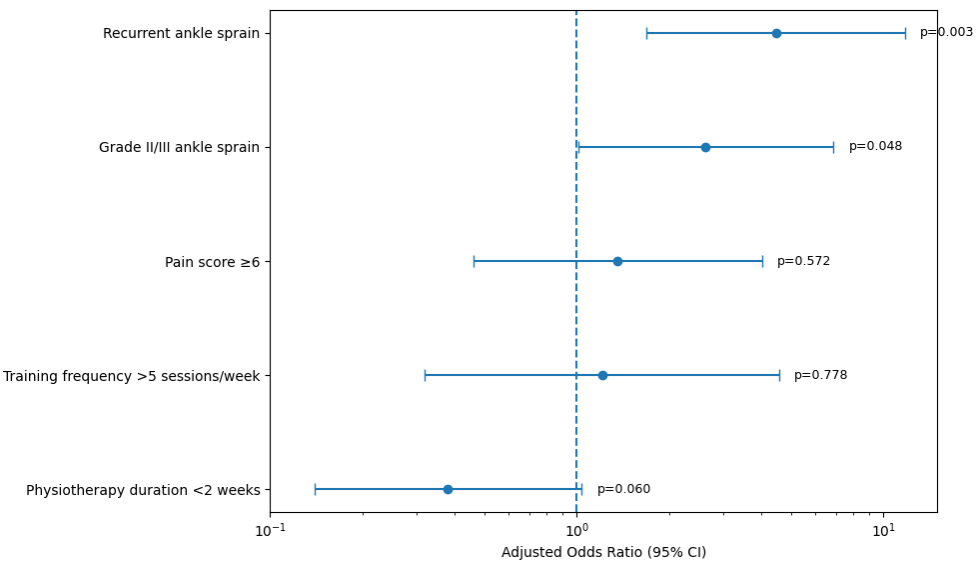
Background: Ankle sprains can be a frequent sports injury that can lead to recurrent instability and chronic functional impairment in university athletes. This study aims to quantify ankle sprain burden, assess the functional consequences of ankle sprains, and identify factors associated with poor functional outcomes in university athletes receiving physiotherapy. Methods: A cross-sectional study was conducted with a sample of 90 university athletes who had been diagnosed with an ankle sprain and were receiving physiotherapy treatment between January and June 2024. Data were collected using a structured questionnaire and clinical assessment form in relation to the demographics, athletic, and injury-related information. Functional status was assessed by the Foot and Ankle Ability Measure (FAAM). Descriptive statistics, chi-square test, and multivariable logistic regression were used, and p<0.05 was considered significant. Results: A total of 55(61.1%) athletes experienced a recurrence of ankle sprains, and 73(81.1%) reported that the mechanism of injury was inversion. Poor functional outcome (FAAM <75%) occurred in 53(58.9%), with a mean FAAM score of 71.8±9.4. Functional impairment was significantly associated with previous sprains (χ²=9.215, p=0.010). Recurrent sprain (AOR 4.46, 95% CI 1.69–11.80; p=0.003) and Grade II/III injury (AOR 2.63, 95% CI 1.01–6.89; p=0.048) independently predicted poor function. Conclusion: There was significant functional disability seen with recurrent and higher-grade ankle sprains. Structured rehabilitation could optimize recovery, and future research should focus on long-term recurrence and return to play in prospective studies.
References
1. Chandran A, Moffit RE, DeJong Lempke AF, Boltz AJ, Alexander AS, Robison HJ, et al. Epidemiology of lateral ligament complex tears of the ankle in National Collegiate Athletic Association (NCAA) sports: 2014-15 through 2018-19. Am J Sports Med. 2023;51(1):169-178. https://doi.org/10.1177/03635465221138281 DOI: https://doi.org/10.1177/03635465221138281
2. Mason J, Kniewasser C, Hollander K, Zech A. Intrinsic risk factors for ankle sprain differ between male and female athletes: a systematic review and meta-analysis. Sports Med Open. 2022;8(1):139. https://doi.org/10.1186/s40798-022-00530-y DOI: https://doi.org/10.1186/s40798-022-00530-y
3. Bagehorn T, de Zee M, Fong DTP, Thorborg K, Kersting UG, Lysdal FG. Lateral ankle joint injuries in indoor and court sports: a systematic video analysis of 445 nonconsecutive case series. Am J Sports Med. 2024;52(6):1572-1584. https://doi.org/10.1177/03635465241241760 DOI: https://doi.org/10.1177/03635465241241760
4. Wikstrom EA, Cain MS, Chandran A, Song K, Regan T, Migel K, et al. Lateral ankle sprain and subsequent ankle sprain risk: a systematic review. J Athl Train. 2021;56(6):578-585. https://doi.org/10.4085/1062-6050-168-20
5. Wagemans J, Bleakley C, Taeymans J, Schurz AP, Kuppens K, Baur H, et al. Exercise-based rehabilitation reduces reinjury following acute lateral ankle sprain: a systematic review update with meta-analysis. PLoS One. 2022;17(2):e0262023. https://doi.org/10.1371/journal.pone.0262023
6. Zhang C, Chen N, Wang J, Zhang Z, Jiang C, Chen Z, et al. The prevalence and characteristics of chronic ankle instability in elite athletes of different sports: a cross-sectional study. J Clin Med. 2022;11(24):7478. https://doi.org/10.3390/jcm11247478 DOI: https://doi.org/10.3390/jcm11247478
7. Dolan P, Kenny I, Glynn L, Campbell M, Warrington GD, Cahalan R, et al. Risk factors for acute ankle sprains in field-based, team contact sports: a systematic review of prospective etiological studies. Phys Sportsmed. 2023;51(6):517-530. https://doi.org/10.1080/00913847.2022.2093618 DOI: https://doi.org/10.1080/00913847.2022.2093618
8. Hansen CF, Obionu KC, Comins JD, Krogsgaard MR. Patient-reported outcome measures for ankle instability: an analysis of 17 existing questionnaires. Foot Ankle Surg. 2022;28(3):288-293. https://doi.org/10.1016/j.fas.2021.04.009 DOI: https://doi.org/10.1016/j.fas.2021.04.009
9. Lam KC, Marshall AN, Holland B, Bay RC, Wikstrom EA, Snyder Valier AR. Patients experience significant and meaningful changes in self-report of function during the first 2 weeks after an ankle sprain injury: a report from the Athletic Training Practice-Based Research Network. J Sport Rehabil. 2023;32(2):117-123. https://doi.org/10.1123/jsr.2022-0014 DOI: https://doi.org/10.1123/jsr.2022-0014
10. Mollà-Casanova S, Inglés M, Serra-Añó P. Effects of balance training on functionality, ankle instability, and dynamic balance outcomes in people with chronic ankle instability: systematic review and meta-analysis. Clin Rehabil. 2021;35(12):1694-1709. https://doi.org/10.1177/02692155211022009
11. Wilczyński B, Cabaj P, Biały M, Zorena K. Impact of lateral ankle sprains on physical function, range of motion, isometric strength and balance in professional soccer players. BMJ Open Sport Exerc Med. 2024;10(4):e002293. https://doi.org/10.1136/bmjsem-2024-002293 DOI: https://doi.org/10.1136/bmjsem-2024-002293
12. Matheny LM, Gittner K, Harding J, Clanton TO. Patient reported outcome measures in the foot and ankle: normative values do not reflect 100% full function. Knee Surg Sports Traumatol Arthrosc. 2021;29(4):1276-1283. https://doi.org/10.1007/s00167-020-06069-3 DOI: https://doi.org/10.1007/s00167-020-06069-3
13. Jiang H, Mei Q, Wang Y, Yang X, Liew BXW, Fernandez J, et al. Towards the strategies of return to sport after lateral ankle sprain: a systematic review. Ann Med. 2025;57(1):2586334. https://doi.org/10.1080/07853890.2025.2586334 DOI: https://doi.org/10.1080/07853890.2025.2586334
14. Sullivan KM, Dean A, Soe MM. OpenEpi: a web-based epidemiologic and statistical calculator for public health. Public Health Rep. 2009;124(3):471–474. https://doi.org/10.1177/003335490912400320 DOI: https://doi.org/10.1177/003335490912400320
15. Nisa ZU, Zaheer A, Jafri MR, Waqas M, Kaur J, Naseer R. Frequency and reoccurrence of ankle sprain in young male athletes of University of Lahore. Pak J Phys Ther. 2021;3(4):7–11. https://doi.org/10.52229/pjpt.v3i4.896 DOI: https://doi.org/10.52229/pjpt.v3i4.896
16. Lin CI, Houtenbos S, Lu YH, Mayer F, Wippert PM. The epidemiology of chronic ankle instability with perceived ankle instability: a systematic review. J Foot Ankle Res. 2021;14(1):41. https://doi.org/10.1186/s13047-021-00480-w DOI: https://doi.org/10.1186/s13047-021-00480-w
17. Wikstrom EA, Cain MS, Chandran A, Song K, Regan T, Migel K, et al. Lateral ankle sprain and subsequent ankle sprain risk: a systematic review. J Athl Train. 2021;56(6):578–585. https://doi.org/10.4085/1062-6050-168-20 DOI: https://doi.org/10.4085/1062-6050-168-20
18. Michels F, Wastyn H, Pottel H, Stockmans F, Vereecke E, Matricali G. The presence of persistent symptoms 12 months following a first lateral ankle sprain: a systematic review and meta-analysis. Foot Ankle Surg. 2022;28(7):817–826. https://doi.org/10.1016/j.fas.2021.12.002 DOI: https://doi.org/10.1016/j.fas.2021.12.002
19. Goulart Neto AM, Maffulli N, Migliorini F, de Menezes FS, Okubo R. Validation of Foot and Ankle Ability Measure (FAAM) and the Foot and Ankle Outcome Score (FAOS) in individuals with chronic ankle instability: a cross-sectional observational study. J Orthop Surg Res. 2022;17(1):38. https://doi.org/10.1186/s13018-022-02925-9 DOI: https://doi.org/10.1186/s13018-022-02925-9
20. Suttmiller AMB, Cavallario JM, Baez SE, Martinez JC, McCann RS. Perceived instability, pain, and psychological factors for prediction of function and disability in individuals with chronic ankle instability. J Athl Train. 2022;57(11-12):1048–1054. https://doi.org/10.4085/1062-6050-0605.21 DOI: https://doi.org/10.4085/1062-6050-0605.21
21. Wagemans J, Bleakley C, Taeymans J, Schurz AP, Kuppens K, Baur H, et al. Exercise-based rehabilitation reduces reinjury following acute lateral ankle sprain: a systematic review update with meta-analysis. PLoS One. 2022;17(2). https://doi.org/10.1371/journal.pone.0262023 DOI: https://doi.org/10.1371/journal.pone.0262023
22. Mollà-Casanova S, Inglés M, Serra-Añó P. Effects of balance training on functionality, ankle instability, and dynamic balance outcomes in people with chronic ankle instability: systematic review and meta-analysis. Clin Rehabil. 2021;35(12):1694–1709. https://doi.org/10.1177/02692155211022009 DOI: https://doi.org/10.1177/02692155211022009
23. Koshino Y, Kobayashi T. Effects of conservative interventions on static and dynamic balance in individuals with chronic ankle instability: a systematic review and meta-analysis. Arch Phys Med Rehabil. 2023;104(4):673–685. https://doi.org/10.1016/j.apmr.2022.10.014 DOI: https://doi.org/10.1016/j.apmr.2022.10.014
24. Luan L, Adams R, Witchalls J, Ganderton C, Han J. Does strength training for chronic ankle instability improve balance and patient-reported outcomes and by clinically detectable amounts? A systematic review and meta-analysis. Phys Ther. 2021;101(7). https://doi.org/10.1093/ptj/pzab046 DOI: https://doi.org/10.1093/ptj/pzab046
25. Guo Y, Cheng T, Yang Z, Huang Y, Li M, Wang T. A systematic review and meta-analysis of balance training in patients with chronic ankle instability. Syst Rev. 2024;13(1):64. https://doi.org/10.1186/s13643-024-02455-x DOI: https://doi.org/10.1186/s13643-024-02455-x
26. Rowe PL, Bryant AL, Egerton T, Paterson KL. External ankle support and ankle biomechanics in chronic ankle instability: systematic review and meta-analysis. J Athl Train. 2023;58(7-8):635–647. https://doi.org/10.4085/1062-6050-0208.22 DOI: https://doi.org/10.4085/1062-6050-0208.22
27. Hu X, Feng T, Li P, Liao J, Wang L. Bilateral sensorimotor impairments in individuals with unilateral chronic ankle instability: a systematic review and meta-analysis. Sports Med Open. 2024;10(1):33. https://doi.org/10.1186/s40798-024-00702-y DOI: https://doi.org/10.1186/s40798-024-00702-y
Published
Issue
Section
License
Copyright (c) 2026 Mehmona Inam, Habib Ullah

This work is licensed under a Creative Commons Attribution-NonCommercial 4.0 International License.
Journal of Women's Health, Reproductive Medicine and Physiology (JWHRMP) follows the Attribution Creative Commons-Non commercial (CC BY-NC 4.0) license which allows the users to copy and redistribute the material in any medium or format, remix, transform and build upon the material. The users must give credit to the source and indicate, provide a link to the license, and indicate if changes were made. However, the CC BY-NC 4.0 license restricts the use of material for commercial purposes (Further details are available at website. The Editorial Board of the JWHRMP endeavors to ensure the accuracy, integrity, and quality of all published content. However, the responsibility of opinions, interpretations, and conclusions expressed in the published articles rests entirely with the authors and do not necessarily reflect the views of the Editorial Board, publisher, or affiliated institutions.