
Serum Neurotrophic Factor Levels and Their Association with Cognitive Performance and Disease Severity in Alzheimer’s Disease
DOI:
https://doi.org/10.68041/jwhrmp.v1i1/02Keywords:
Alzheimer Disease, Biomarkers, Brain-Derived Neurotrophic Factor, Cognition, Disease Progression, Enzyme-Linked Immunosorbent Assay, Nerve Growth FactorAbstract
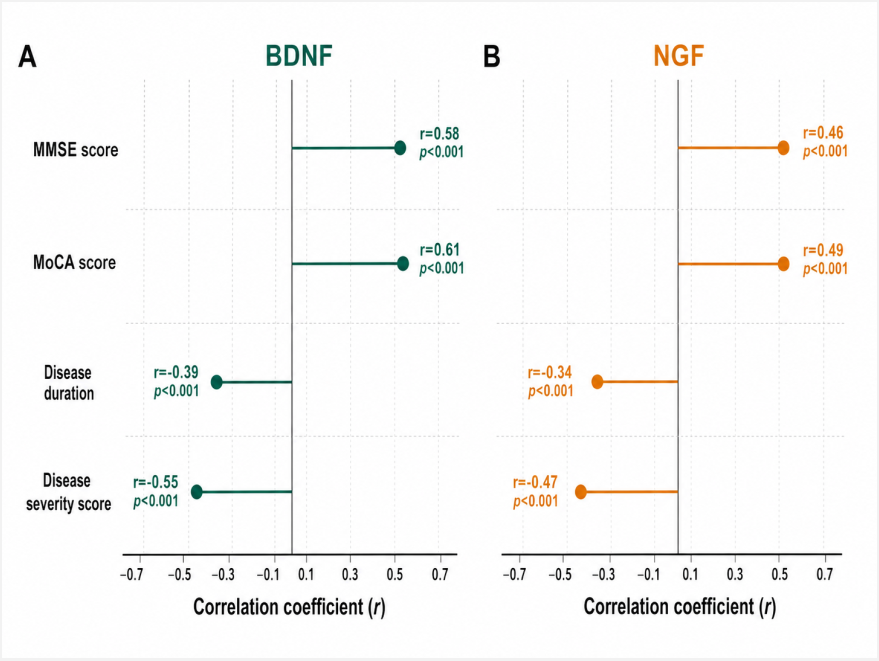
Background: Alzheimer's disease (AD) is a progressive, neurodegenerative disease that leads to cognitive decline. This study aimed to compare serum Brain-Derived Neurotrophic Factor (BDNF) and Nerve Growth Factor (NGF) levels between AD patients and normal controls and to evaluate correlation with cognition and the severity of the disease. Methods: This cross-sectional analytical study included 145 participants (105 patients and 40 normal controls). The Mini-Mental State Examination (MMSE) and Montreal Cognitive Assessment (MoCA) were used to measure cognitive function, and AD severity was graded as mild, moderate, or severe. Enzyme-linked immunosorbent assay (ELISA) was used to measure serum BDNF and NGF, which were correlated and tested for their diagnostic performance and associated factors of severity. Results: Serum BDNF and NGF were significantly lower in AD patients than controls (11.24 ± 3.42 vs 17.86 ± 4.11 ng/mL and 38.7 ± 11.5 vs 56.9 ± 13.2 pg/mL, respectively; both p<0.001). Both decreased from mild to severe AD (trend p<0.001). BDNF correlated with MMSE (r=0.58) and MoCA (r=0.61), while NGF correlated with MMSE (r=0.46) and MoCA (r=0.49); all p<0.001. The joint performance of BDNF and NGF showed 86.7% sensitivity and 82.5% specificity, with an AUC of 0.90. There was a positive association with severity between low BDNF, low NGF, and disease duration >5 years. Conclusion: Lower serum BDNF and NGF were correlated with worse cognition and higher severity of AD, indicating their potential as adjunctive biomarkers. Further multicenter studies should be conducted to confirm their future use for monitoring disease progression and treatment response
References
1. Yin M, Ding S, Zhao M, Liu J, Su W, Fu M, et al. The global, regional, and national burden and attributable risk factors of Alzheimer's disease and other dementias, 1990-2021: A systematic analysis for the Global Burden of Disease Study. J Alzheimers Dis. 2025;107(1):192-206. https://doi.org/10.1177/13872877251360221 DOI: https://doi.org/10.1177/13872877251360221
2. Wang G, Estrella A, Hakim O, Milazzo P, Patel S, Pintagro C, et al. Mini-Mental State Examination and Montreal Cognitive Assessment as tools for following cognitive changes in Alzheimer's Disease Neuroimaging Initiative participants. J Alzheimers Dis. 2022;90(1):263-270. https://doi.org/10.3233/JAD-220397 DOI: https://doi.org/10.3233/JAD-220397
3. Pahlke S, Kahale LA, Mahinrad S, Sousa-Pinto B, Vieira RJ, McAteer MB, et al. Blood-based biomarkers for detecting Alzheimer's disease pathology in cognitively impaired individuals within specialized care settings: A systematic review and meta-analysis. Alzheimers Dement. 2025;21(11):e70828. https://doi.org/10.1002/alz.70828
4. Islam N, Hashem R, Gad M, Brown A, Levis B, Renoux C, et al. Accuracy of the Montreal Cognitive Assessment tool for detecting mild cognitive impairment: A systematic review and meta-analysis. Alzheimers Dement. 2023;19(7):3235-3243. https://doi.org/10.1002/alz.13040 DOI: https://doi.org/10.1002/alz.13040
5. Nikolac Perkovic M, Borovecki F, Filipcic I, Vuic B, Milos T, Nedic Erjavec G, et al. Relationship between brain-derived neurotrophic factor and cognitive decline in patients with mild cognitive impairment and dementia. Biomolecules. 2023;13(3):570. https://doi.org/10.3390/biom13030570 DOI: https://doi.org/10.3390/biom13030570
6. Lu H, Fang Y, Chen X, Zhang W, Wang Y. Study on the relationship between cerebral blood perfusion, neuronal cytokines and cognitive function in patients with Alzheimer's disease. Actas Esp Psiquiatr. 2024;52(3):238-247. https://doi.org/10.62641/aep.v52i3.1630
7. Angelucci F, Veverova K, Katonová A, Vyhnalek M, Hort J. Serum PAI-1/BDNF ratio is increased in Alzheimer's disease and correlates with disease severity. ACS Omega. 2023;8(39):36025-36031. https://doi.org/10.1021/acsomega.3c04076
8. Wang T, Li T, Hao S, Han Y, Cai Y. Association of plasma BDNF levels with different stages of Alzheimer's disease: A cross-sectional study. Neurol Res. 2023;45(3):234-240. https://doi.org/10.1080/01616412.2022.2129760 DOI: https://doi.org/10.1080/01616412.2022.2129760
9. Pentz R, Iulita MF, Ducatenzeiler A, Bennett DA, Cuello AC. The human brain NGF metabolic pathway is impaired in the pre-clinical and clinical continuum of Alzheimer's disease. Mol Psychiatry. 2021;26(10):6023-6037. https://doi.org/10.1038/s41380-020-0797-2
10. Pentz R, Iulita MF, Ducatenzeiler A, Videla L, Benejam B, Carmona-Iragui M, et al. Nerve growth factor (NGF) pathway biomarkers in Down syndrome prior to and after the onset of clinical Alzheimer's disease: A paired CSF and plasma study. Alzheimers Dement. 2021;17(4):605-617. https://doi.org/10.1002/alz.12229 DOI: https://doi.org/10.1002/alz.12229
11. Piancatelli D, Aureli A, Sebastiani P, Colanardi A, Del Beato T, Del Cane L, et al. Gene- and gender-related decrease in serum BDNF levels in Alzheimer's disease. Int J Mol Sci. 2022;23(23):14599. https://doi.org/10.3390/ijms232314599
12. Xie B, Zhou H, Liu W, Yu W, Liu Z, Jiang L, et al. Evaluation of the diagnostic value of peripheral BDNF levels for Alzheimer's disease and mild cognitive impairment: Results of a meta-analysis. Int J Neurosci. 2020;130(3):218-230. https://doi.org/10.1080/00207454.2019.166779
13. Sullivan KM, Dean A, Soe MM. OpenEpi: a web-based epidemiologic and statistical calculator for public health. Public Health Rep. 2009;124(3):471–474. https://doi.org/10.1177/003335490912400320 DOI: https://doi.org/10.1177/003335490912400320
14. Lu H, Fang Y, Chen X, Zhang W, Wang Y. Study on the relationship between cerebral blood perfusion, neuronal cytokines and cognitive function in patients with Alzheimer's disease. Actas Esp Psiquiatr. 2024;52(3):238-247. https://doi.org/10.62641/aep.v52i3.1630
15. Piancatelli D, Aureli A, Sebastiani P, Colanardi A, Del Beato T, Del Cane L, et al. Gene- and gender-related decrease in serum BDNF levels in Alzheimer's disease. Int J Mol Sci. 2022;23(23):14599. https://doi.org/10.3390/ijms232314599 DOI: https://doi.org/10.3390/ijms232314599
16. Angelucci F, Veverova K, Katonová A, Vyhnalek M, Hort J. Serum PAI-1/BDNF ratio is increased in Alzheimer's disease and correlates with disease severity. ACS Omega. 2023;8(39):36025-36031. https://doi.org/10.1021/acsomega.3c04076 DOI: https://doi.org/10.1021/acsomega.3c04076
17. Lu H, Fang Y, Chen X, Zhang W, Wang Y. Study on the relationship between cerebral blood perfusion, neuronal cytokines and cognitive function in patients with Alzheimer's disease. Actas Esp Psiquiatr. 2024;52(3):238-247. https://doi.org/10.62641/aep.v52i3.1630 DOI: https://doi.org/10.62641/aep.v52i3.1630
18. Kim K, Byun MS, Yi D, Jung JH, Sohn BK, Jung G, et al. Serum BDNF and progression to MCI in cognitively normal older adults: A prospective cohort study. J Prev Alzheimers Dis. 2025;12(7):100210. https://doi.org/10.1016/j.tjpad.2025.100210 DOI: https://doi.org/10.1016/j.tjpad.2025.100210
19. Pentz R, Iulita MF, Ducatenzeiler A, Bennett DA, Cuello AC. The human brain NGF metabolic pathway is impaired in the pre-clinical and clinical continuum of Alzheimer's disease. Mol Psychiatry. 2021;26(10):6023-6037. https://doi.org/10.1038/s41380-020-0797-2 DOI: https://doi.org/10.1038/s41380-020-0797-2
20. Keegan AP, Stough C, Paris D, Luis CA, Abdullah L, Ait-Ghezala G, et al. Baseline serum brain-derived neurotrophic factor association with future cognition in community-dwelling older adults undergoing annual memory screening. Neurol Res. 2024;46(3):253-260. https://doi.org/10.1080/01616412.2023.2294581 DOI: https://doi.org/10.1080/01616412.2023.2294581
21. Tsai MJ, Lin YS, Chen CY, Lee WJ, Fuh JL. Serum brain-derived neurotrophic factor levels as a predictor for Alzheimer disease progression. J Chin Med Assoc. 2023;86(11):960-965. https://doi.org/10.1097/JCMA.0000000000000991 DOI: https://doi.org/10.1097/JCMA.0000000000000991
22. Wang Y, Li Y, Li Y, Li T, Wang Q, Wang Q, et al. A blood-based composite panel that screens Alzheimer's disease. Biomark Res. 2023;11(1):53. https://doi.org/10.1186/s40364-023-00485-6 DOI: https://doi.org/10.1186/s40364-023-00485-6
23. Xie B, Zhou H, Liu W, Yu W, Liu Z, Jiang L, et al. Evaluation of the diagnostic value of peripheral BDNF levels for Alzheimer's disease and mild cognitive impairment: Results of a meta-analysis. Int J Neurosci. 2020;130(3):218-230. https://doi.org/10.1080/00207454.2019.1667794 DOI: https://doi.org/10.1080/00207454.2019.1667794
24. Xu C, Zhao L, Dong C. The performance of plasma phosphorylated tau231 in detecting Alzheimer's disease: A systematic review with meta-analysis. Eur J Neurosci. 2023;58(4):3132-3149. https://doi.org/10.1111/ejn.16085 DOI: https://doi.org/10.1111/ejn.16085
25. Pahlke S, Kahale LA, Mahinrad S, Sousa-Pinto B, Vieira RJ, McAteer MB, et al. Blood-based biomarkers for detecting Alzheimer's disease pathology in cognitively impaired individuals within specialized care settings: A systematic review and meta-analysis. Alzheimers Dement. 2025;21(11):e70828. https://doi.org/10.1002/alz.70828 DOI: https://doi.org/10.1002/alz.70828
26. Figueiredo RG, Patino CM, Ferreira JC. Cross-sectional studies: understanding applications, methodological issues, and valuable insights. J Bras Pneumol. 2025;51(1):e20250047. https://doi.org/10.36416/1806-3756/e20250047 DOI: https://doi.org/10.36416/1806-3756/e20250047
Published
Issue
Section
License
Copyright (c) 2026 Saeeda Ahmed, Muhammad Abdullah, Khadeejah Qadir, Shareefa Bint-e Umar

This work is licensed under a Creative Commons Attribution-NonCommercial 4.0 International License.
Journal of Women's Health, Reproductive Medicine and Physiology (JWHRMP) follows the Attribution Creative Commons-Non commercial (CC BY-NC 4.0) license which allows the users to copy and redistribute the material in any medium or format, remix, transform and build upon the material. The users must give credit to the source and indicate, provide a link to the license, and indicate if changes were made. However, the CC BY-NC 4.0 license restricts the use of material for commercial purposes (Further details are available at website. The Editorial Board of the JWHRMP endeavors to ensure the accuracy, integrity, and quality of all published content. However, the responsibility of opinions, interpretations, and conclusions expressed in the published articles rests entirely with the authors and do not necessarily reflect the views of the Editorial Board, publisher, or affiliated institutions.