
Awareness of Cervical Cancer Screening Among Women Attending Gynecology Clinics
DOI:
https://doi.org/10.68041/jwhrmp.v1i1/04Keywords:
Uterine Cervical Neoplasms, Mass Screening, Papanicolaou Test, Papillomavirus Infections, Health Knowledge, Attitudes, Practice, Health EducationAbstract
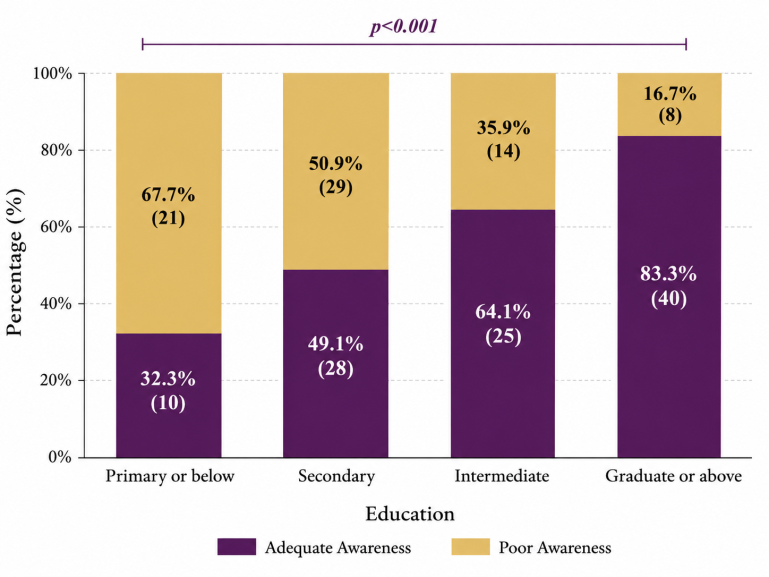
Background: Cervical cancer is preventable and can be detected early with screening, which can help to lower the morbidity and mortality from the disease. The purpose of this study was to determine the awareness of women's screening for cervical cancer in gynecology clinics. Methods: This cross-sectional descriptive study included 175 women attending gynecology clinics. A structured interviewer-administered questionnaire was used to collect data, which included information on cervical cancer prevention, Pap smear testing, HPV infection testing, screening without symptoms, previous gynecological consultation, and sources of information about screening. A score of awareness was computed, and participants were divided into good, moderate, or poor awareness. Relationships with sociodemographic and health-care related factors were explored. Results: In general, 103(58.9%) of women were aware, and 72(41.1%) were not aware. Of the 121 respondents (69.1%) who recognized Pap smear as a screening test, 68 (38.9%) knew that HPV testing could be used for screening, and 83 (47.4%) knew that screening might be recommended when there are no symptoms. There was a significant increase in awareness, from 32.3% for women with primary education or less to 83.3% for women with graduate education (p<0.001). Conclusion: Awareness was moderate, with key gaps in knowledge around HPV-based screening and symptom-independent screening. Clinic-based education and subsequent intervention studies should reinforce informed participation in screening, particularly among women who have not been extensively educated or provided with information.
References
1. Li Z, Liu P, Yin A, Zhang B, Xu J, Chen Z, et al. Global landscape of cervical cancer incidence and mortality in 2022 and predictions to 2030: The urgent need to address inequalities in cervical cancer. Int J Cancer. 2025;157(2):288-297. https://doi.org/10.1002/ijc.35369 DOI: https://doi.org/10.1002/ijc.35369
2. Gupta R, Singh S, Gupta S. Performance characteristics of the point-of-care tests for HPV-based cervical cancer screening: a systematic review and meta-analysis. J Public Health (Oxf). 2025;47(1):e106-e115. https://doi.org/10.1093/pubmed/fdae306 DOI: https://doi.org/10.1093/pubmed/fdae306
3. Terasawa T, Hosono S, Sasaki S, Hoshi K, Hamashima Y, Katayama T, et al. Comparative accuracy of cervical cancer screening strategies in healthy asymptomatic women: a systematic review and network meta-analysis. Sci Rep. 2022;12(1):94. https://doi.org/10.1038/s41598-021-04201-y DOI: https://doi.org/10.1038/s41598-021-04201-y
4. Canfell K, Kim JJ, Brisson M, Keane A, Simms KT, Caruana M, et al. Mortality impact of achieving WHO cervical cancer elimination targets: a comparative modelling analysis in 78 low-income and lower-middle-income countries. Lancet. 2020;395(10224):591-603. https://doi.org/10.1016/S0140-6736(20)30157-4 DOI: https://doi.org/10.1016/S0140-6736(20)30157-4
5. Farajimakin O. Barriers to cervical cancer screening: A systematic review. Cureus. 2024;16(7):e65555. https://doi.org/10.7759/cureus.65555 DOI: https://doi.org/10.7759/cureus.65555
6. Appiah RS, Boakye K, Appiah G, Aidoo AA, Acquah-Hagan G, Singh B, et al. Rural-urban variations in cervical cancer screening uptake among women in Ghana: Evidence from the 2022 Ghana Demographic and Health Survey. BMC Womens Health. 2025;25(1):255. https://doi.org/10.1186/s12905-025-03802-3 DOI: https://doi.org/10.1186/s12905-025-03802-3
7. MacLaughlin KL, Jenkins GD, St Sauver J, Fan C, Miller NE, Meyer AF, et al. Primary human papillomavirus testing by clinician- versus self-collection: Awareness and acceptance among cervical cancer screening-eligible women. J Med Screen. 2024;31(4):223-231. https://doi.org/10.1177/09691413241260019 DOI: https://doi.org/10.1177/09691413241260019
8. Riaz L, Manazir S, Jawed F, Ali SA, Riaz R. Knowledge, perception, and prevention practices related to human papillomavirus-based cervical cancer and its socioeconomic correlates among women in Karachi, Pakistan. Cureus. 2020;12(3):e7183. https://doi.org/10.7759/cureus.7183 DOI: https://doi.org/10.7759/cureus.7183
9. Sharif M, Majeed HK, Tagar K, Lohana S, Rauf A, Sharif M, et al. Reproductive health-related knowledge, attitude, and practices in women of reproductive age in underdeveloped areas of Punjab, Pakistan. Cureus. 2022;14(11):e31043. https://doi.org/10.7759/cureus.31043 DOI: https://doi.org/10.7759/cureus.31043
10. Rana T, Chan DNS, Law BMH, Choi KC, Shrestha S, So WKW. Determinants of cervical cancer screening utilisation among women in the least developed countries: A systematic review and meta-analysis. PLoS One. 2025;20(6):e0321627. https://doi.org/10.1371/journal.pone.0321627 DOI: https://doi.org/10.1371/journal.pone.0321627
11. Zhang M, Sit JWH, Chan DNS, Akingbade O, Chan CWH. Educational interventions to promote cervical cancer screening among rural populations: A systematic review. Int J Environ Res Public Health. 2022;19(11):6874. https://doi.org/10.3390/ijerph19116874 DOI: https://doi.org/10.3390/ijerph19116874
12. Kolambkar S, Tomar M, Arif N, Hussain S, Gupta E, Singh S. HPV vaccination in the WHO South-East Asia Region: a scoping review of uptake, implementation challenges, and pathways to acceleration. Hum Vaccin Immunother. 2026;22(1):2693359. https://doi.org/10.1080/21645515.2026.2693359 DOI: https://doi.org/10.1080/21645515.2026.2693359
13. Sullivan KM, Dean A, Soe MM. OpenEpi: a web-based epidemiologic and statistical calculator for public health. Public Health Rep. 2009;124(3):471–474. https://doi.org/10.1177/003335490912400320 DOI: https://doi.org/10.1177/003335490912400320
14. Aynalem BY, Anteneh KT, Enyew MM. Knowledge, attitudes, and associated factors of cervical cancer screening among women in Debre Markos town, Northwest Ethiopia: a cross-sectional study. Sci Rep. 2025;15(1):34726. https://doi.org/10.1038/s41598-025-18296-0 DOI: https://doi.org/10.1038/s41598-025-18296-0
15. Al Yahyai T, Al Raisi M, Al Kindi R. Knowledge, attitudes, and practices regarding cervical cancer screening among Omani women attending primary healthcare centers in Oman: a cross-sectional survey. Asian Pac J Cancer Prev. 2021;22(3):775-783. https://doi.org/10.31557/APJCP.2021.22.3.775 DOI: https://doi.org/10.31557/APJCP.2021.22.3.775
16. Zahid HM, Qarah AB, Alharbi AM, Alomar AE, Almubarak SA. Awareness and practices related to cervical cancer among females in Saudi Arabia. Int J Environ Res Public Health. 2022;19(3):1455. https://doi.org/10.3390/ijerph19031455 DOI: https://doi.org/10.3390/ijerph19031455
17. Al Ghamdi NH. Knowledge of human papilloma virus (HPV), HPV-vaccine and Pap smear among adult Saudi women. J Family Med Prim Care. 2022;11(6):2989-2999. https://doi.org/10.4103/jfmpc.jfmpc_2094_21 DOI: https://doi.org/10.4103/jfmpc.jfmpc_2094_21
18. Miglani I, Gandhi U, Laul P. Knowledge, attitude, and practices of the educated women of North India toward cervical cancer. Indian J Community Med. 2025;50(1):202-206. https://doi.org/10.4103/ijcm.ijcm_258_23 DOI: https://doi.org/10.4103/ijcm.ijcm_258_23
19. Khomphaiboonkij U, Sreamsukcharoenchai N, Pitakkarnkul S, Rittiluechai K, Tangjitgamol S. Knowledge of Thai women in cervical cancer etiology and screening. PLoS One. 2023;18(5):e0286011. https://doi.org/10.1371/journal.pone.0286011 DOI: https://doi.org/10.1371/journal.pone.0286011
20. Aldeyain SJ, Alkhulaifi NS, Almutairi FM, Alenezi RS, Almutairi GM, Alaazmy YA, et al. Knowledge, attitudes and practice toward cervical cancer and its screening among women in Kuwait: a cross-sectional study. J Family Med Prim Care. 2026;15(2):750-755. https://doi.org/10.4103/jfmpc.jfmpc_1750_25 DOI: https://doi.org/10.4103/jfmpc.jfmpc_1750_25
21. Al-Saadi AN, Al-Muqbali AH, Dawi E. Women’s knowledge of cervical cancer: a cross-sectional study in Al Buraimi Governorate, Oman. Sultan Qaboos Univ Med J. 2021;21(3):450-456. https://doi.org/10.18295/squmj.4.2021.022 DOI: https://doi.org/10.18295/squmj.4.2021.022
22. Kontonikou S, Kyrkou G, Bothou A, Nanou C, Vivilaki V, Deltsidou A. Investigation of women’s knowledge and beliefs about cervical cancer and cervical smear examination: a survey study in Greece. Cureus. 2024;16(12):e75486. https://doi.org/10.7759/cureus.75486 DOI: https://doi.org/10.7759/cureus.75486
23. Qin L, Zhang X, Wu A, Miser JS, Liu YL, Hsu JC, et al. Association between social media use and cancer screening awareness and behavior for people without a cancer diagnosis: matched cohort study. J Med Internet Res. 2021;23(8):e26395. https://doi.org/10.2196/26395 DOI: https://doi.org/10.2196/26395
24. Thiel de Bocanegra H, Dehlendorf C, Kuppermann M, Vangala SS, Moscicki AB. Impact of an educational tool on young women’s knowledge of cervical cancer screening recommendations. Cancer Causes Control. 2022;33(6):813-821. https://doi.org/10.1007/s10552-022-01569-8 DOI: https://doi.org/10.1007/s10552-022-01569-8
25. Al Kindi RM, Al Sumri HH, Al Muhdhoori TM, Al Mamari K, Al Kalbani MA, Al-Azri MH. Knowledge of cervical cancer screening among Omani women attending a university teaching hospital: a cross-sectional study. BMC Womens Health. 2024;24(1):40. https://doi.org/10.1186/s12905-023-02870-7 DOI: https://doi.org/10.1186/s12905-023-02870-7
26. Munizar M, Ar Royan H, Yolanda F. Barriers to cervical cancer screening through Pap smear examination among women attending the Gynecology Polyclinic at Dr. Zainoel Abidin General Hospital in 2024: a cross-sectional study. Asian Pac J Cancer Prev. 2025;26(9):3309-3317. https://doi.org/10.31557/APJCP.2025.26.9.3309 DOI: https://doi.org/10.31557/APJCP.2025.26.9.3309
27. Mohammed E, Taye G, Assefa M, Addissie A, Jemal A. Effect of health education on cervical cancer screening uptake and knowledge among target women in Addis Ababa: a randomized controlled trial. Cancer Prev Res (Phila). 2025;18(12):769-779. https://doi.org/10.1158/1940-6207.CAPR-25-0188 DOI: https://doi.org/10.1158/1940-6207.CAPR-25-0188
Published
Issue
Section
License
Copyright (c) 2026 Aliya Ameen, Shanza Akram, Maham Riaz

This work is licensed under a Creative Commons Attribution-NonCommercial 4.0 International License.
Journal of Women's Health, Reproductive Medicine and Physiology (JWHRMP) follows the Attribution Creative Commons-Non commercial (CC BY-NC 4.0) license which allows the users to copy and redistribute the material in any medium or format, remix, transform and build upon the material. The users must give credit to the source and indicate, provide a link to the license, and indicate if changes were made. However, the CC BY-NC 4.0 license restricts the use of material for commercial purposes (Further details are available at website. The Editorial Board of the JWHRMP endeavors to ensure the accuracy, integrity, and quality of all published content. However, the responsibility of opinions, interpretations, and conclusions expressed in the published articles rests entirely with the authors and do not necessarily reflect the views of the Editorial Board, publisher, or affiliated institutions.